 I’ve been thinking long and hard about this week’s blog. Morning Coffee is not a political blog. It never has been and it never will be. My beliefs are mine, yours are yours, and that’s the way it should be. That’s the beauty of living in this country. But I feel compelled, with all that’s been done and reported over the last year, and most particularly as of late, to remind everyone of the history behind the Star Spangled Banner. Most of you will remember at least part of this from grade school.
In September of 1814, Francis Scott Key, a 35 year old lawyer, witnessed from a distance the Battle of Baltimore at Fort McHenry. Only weeks before the British had marched on Washington and burned the Capital, the Treasury, and the White House. They were now waging a sea battle against American soldiers on shore. For 25 hours Key watched from an American warship as British ships bombarded Fort McHenry with shells and rockets. From a distance of eight miles away, he was certain our men were outnumbered, outgunned, and would surely lose. But when the sun rose that final morning of September 15th he could see our flag still flying high over the fort and it so moved him that he penned the words we still sing today, putting them to the tune of a popular English song of the time.
The flag, which became known as the Star Spangled Banner, was 30×42 feet and had fifteen stars and fifteen stripes. It was sewn by Mary Young Pickersgill, a 29 year old widow and professional flag maker, along with her daughter, three nieces, a 13 year old indentured servant, and possibly Mary’s mother. It took 300 yards of English wool bunting and each cotton star measured two feet in diameter. She was paid $405.90. She was paid an additional $168.54 to make a smaller identical “storm” flag of 17×25 feet which hung over the fort during the battle. Over the years, pieces of the original flag were clipped and awarded to various individuals. What remains of the flag is on display in the National Museum of American History in Washington DC.
While the song was used by the Navy in 1889 and President Woodrow Wilson in 1916, it did not become our official national anthem until March 3, 1931, under President Herbert Hoover.
But when did we begin regularly singing it before sporting events? That would be WWI and game one of the 1918 World Series. The two teams playing for the pennant that year were the Boston Red Sox (including Babe Ruth) and the Chicago Cubs, with game one hosted by Chicago on September 5th. Both teams had won six of the last fifteen championship titles. Despite this the mood was somber and attendance was lower than usual. In the year and half since the US had entered the Great War more than 100,000 soldiers had been lost, a bomb had exploded in Chicago the day before killing four people and injuring dozens more, and the Spanish Flu epidemic was beginning to sweep the nation.
But when the US Navy band struck up the Star Spangled Banner during the seventh inning something in the atmosphere changed. Red Sox infielder Fred Thomas, a Navy man granted furlough in order to play in the series, immediately turned to face the flag and give it a military salute. Other players turned with hands over their hearts as the already standing crowd began to sing. When the song ended, the previously quiet crowd broke into thunderous applause and the game continued. The song would be played at every Series game after. The Red Sox gave out free tickets to wounded veterans and honored them during the playing of the song at the sixth and final game. (The Red Sox won that year, four games to two.)
Red Sox owner Harry Frazee made it a regular part of all Boston home games. Other baseball parks began playing the anthem on holidays and at special events. By the end of WWII, NFL Commissioner Elmer Layden ordered it played at all football games and it soon spread to other sports, made easier and grander by the use of large sound systems and post-war patriotism.
Controversy over the practice is nothing new. In 1954, Baltimore Orioles general manager Arthur Ehlers briefly stopped playing the anthem altogether, complaining that too many fans were disrespecting the anthem by talking and laughing while it was played. He quickly gave in under pressure, though, and reinstated it a short month later.
While there will always be those protesting on either side of the issue, no matter what side with which you align yourself, never forget that it’s because we live in such a great country that we are even allowed to have contradicting views, and allowed to voice them, without fear. For that right we must always remember and honor those who fought, especially those who died, that we might have this freedom.
 I was told to always carry my business cards with me because you just never know. Last December I switched purses to go to a Christmas party. The new bag was much smaller and as I held the card case in my hand I thought to myself, “No one’s going to ask for a card at a Christmas party. It’s not that kind of party.” So I left it in my every day purse and, wouldn’t you know it, someone asked for my card. She chastised me, and rightly so, for not having some cards with me.
 I am on vacation this week. A much needed get-away to celebrate my retirement with my sister on the west coast. So I will simply leave you with one of my poems. This was written years ago from a childhood memory. We lived on a hill and after a summer rain my two oldest brothers and I would rush outside to race our “ships” down the flooded gutter.
 A couple weeks ago I wrote about my author friend Tina Susedik. This week I want to tell you about another, Beth James. Beth self-publishes and currently has three books available on Amazon. A fourth will be out soon…I hope.
 We’ve all been disappointed after spending money on an Amazon deal for a self-published book that was not very good: confusing plot, horrendous grammar and punctuation, and all the typos. (Drives me crazy! I even marked up one with my red pen and then threw it away when I was finished. And it was a really good story.) As I said earlier, if smart, a self-published writer will pay a professional editor to catch what they’ve missed. Fortunately, not all self-published authors are that untalented or sloppy. Beth is one of the outstanding ones.
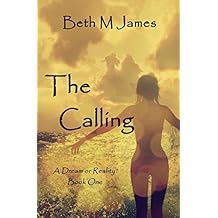 Then why not go the traditional route? There are many reasons. Even good novels can’t always find a publisher. The publishing business is tough. They get inundated with submissions, many not so good, but many are really good and they just can’t take them all. It comes down to cost vs income. They need to pay their bills, too. Some authors prefer to keep complete control over their work. They don’t want to have to make edits they don’t like. They don’t want to accept a cover design that doesn’t represent their view of the story. As for profits, publishers and agents do get a percentage of the sales and not all authors are willing to pay that when they believe they can do the job just as well themselves and keep all the profits. It’s all about control.
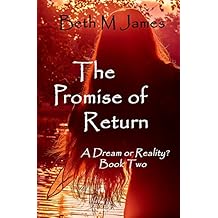 I recently finished reading Beth’s “The Promise of Return”, book 2 of her three book series “A Dream or Reality”, and I can’t wait for book 3 to find out what happens. After book 3 I may have to back track and buy her debut stand-alone novel, “Gitana – Life Plan”. I hear that’s another great read.
 Jane Yunker, Author