In my planning and researching for “Where Flowers Bloom”, I came across rules for teachers in 1872, which I shared here last week. There were also School Rules. (“Frontier Teachers: Stories of Heroic Women of the Old West” by Chris Enss.)
“Teachers on the frontier often used any facility available for a classroom: canvas tents, sod houses, barns, or abandoned mining shacks. Supplies were limited. Where readers were absent, Bibles and Sears, Roebuck Catalogs were used to teach children how to read and write. Depending on the size of the town or the mining camp, class size could be as little as three and as many as fifty. Pupils from grades one to eight congregated together in one room. Younger students sat in the front, and older ones were in the back. Girls were on one side, and boys were on the other. The curriculum focused on the basics: reading, spelling, penmanship, arithmetic, and history. Ten-to-fifteen-minute sessions were dedicated to each grade level.
“The length of the school terms was dictated by the farming families. The children of farmers needed to be available to help their parents with the planting and the harvest. A school year was generally twelve weeks long and ran from Thanksgiving to early spring.
“There were stiff penalties for pupils who talked out of turn or forgot to hand in a lesson. Disciplinary measures ranged from standing in the corner and staying after school, to spankings with rulers or hickory switches. Often times the most serious offenders were expelled before corporal punishment was initiated.
“At the end of the year it was customary for many frontier schools to invite parents and townspeople to join the students in a celebratory banquet. School patrons and mothers of students brought baskets filled with food. Before anyone could enjoy the meal [sic] the pupils would reiterate for the guests all they had learned during the term and share the kind thoughts they had about their long-suffering teachers.”
Now that summer is done and autumn has begun, I’ve returned to my desk. This winter I’m challenging myself to write two books. At the request of my readers, one is the sequel to my most recent novel, “Under The Endless Sky”. In my planning and researching for “Where Flowers Bloom”, I came across these rules for teachers in 1872. (“Frontier Teachers: Stories of Heroic Women of the Old West” by Chris Enss.)
Teachers each day will fill lamps, clean chimneys.
Each teacher will bring a bucket of water and a scuttle of coal for the day’s session.
Make your pens carefully. You may whittle nibs to the individual taste of the pupils.
Men teachers may take one evening each week for courting purposes, or two evenings a week if they go to church regularly.
After ten hours in school, the teachers may spend the remaining time reading the Bible or other good books.
Women teachers who marry or engage in unseemly conduct will be dismissed.
Every teacher should lay aside from each pay a goodly sum of his earnings for his benefit during his declining years so that he will not become a burden on society.
Any teacher who smokes, uses liquor in any form, frequents pool or public halls, or gets shaved in a barber shop will give good reason to suspect his worth, intention, integrity and honesty.
The teacher who performs his labor faithfully and without fault for five years will be given an increase of twenty-five cents per week in his pay, providing the Board of Education approves.
In other lists, I’ve seen the additional rule that female teachers were not allowed to go to ice cream parlors. Figure that one out! I guess it falls under rules #6 or #8, although, I’ve seen nothing saying male teachers can’t enjoy an ice cream.
See Frontier Teachers part 2 next month for School Rules.
The Fourth of July is over, county and state fair season is in full swing, and the dog days of summer are upon us. Have you ever wondered what that means? Why are they “dog days”? And when did the saying originate?
The etymology dictionary website, etymonline.com, defines it as a “period of dry, hot weather at the height of summer,” traced back to the 1530s and from the Latin dies caniculares. They occur during the time of the rising of Sirius, the Dog Star.
I fondly remember those August days before a new school year began. Afternoons at the town swimming pool and sucking on a popsicle (root beer the preferred flavor) on the walk home. Cicadas loudly buzzing, the grass brown and crunchy under my feet. Riding my bicycle downhill was the best way to catch a breeze. After dinner it was back outside for a game of kick-the-can with friends until the sun inevitably slipped below the horizon, streetlights blinked on, and our mothers appeared at the front door calling us home. Then off to bed exhausted and looking forward to doing it all over again the next day.
No cell phones, social media, video games, endless streaming services keeping us alone in our bedrooms all day. Only one television and Dad had first call on what was watched. Remote control? We were his remote control.
We were leading the best life. Kids today have no idea what they missed. Perhaps parents can show them by putting their own phones down, unplugging all the electronics, and going outside to play with their children the way they once played with their friends. Teach them kick-the-can. All you need is an empty soup can. You don’t even have to wait for Amazon to deliver one.
The final reward after all the time spent writing a book, is publication day. When you finally get to see your work reach fruition. It’s like your wedding day, the birth of a child, Christmas, and your birthday all rolled into one. That day has come for me once more. My sixth full-length novel, “Under The Endless Sky”, is now available in paperback at Amazon, and ebook at online stores, including Amazon, Barnes and Noble, and Apple.
A story of South Dakota ‘girl homesteaders’ in the late 19th century, it’s about friendship as well as hardship on the prairie for women pursuing the dream of owning land in their own name. And, of course, there’s a touch of romance mixed in.
So, what do I do now? I start work on the next book, of course.
Starting a new WIP is very exciting. Plot lines, characters, who falls in love with who and how, all battle for my attention. This often begins even before I finish my current WIP. That’s a trap I have to be very careful to avoid because chances are good that if I fall for it, the old work will never be finished. Then, neither will the new one since an even newer one is liable to start whispering in my ear. I’ve been fighting this temptation recently by taking notes when the thoughts strike me.
The excitement goes steadily downhill from there, through the middle of the book slog, until I get to type those two wonderful words, “The End.” I celebrated this thrill with wine two weeks ago.
But now the real work begins. After a read-through to see what problems I could spot and fix, “Under The Endless Sky” is with my editor. I know she will find more typos, questionable transitions, and confusing who-is-speaking-here dialogue. Don’t even get me started on whether or not to insert a comma.
Hopefully, the fixes will be minor enough that I don’t have to go through a second round, and can see it downloaded and published. A high point that allows me to move on to those notes I took for the next WIP.
Watch for “Under The Endless Sky” to be available in May 2025.
When you write historical fiction, you have to be diligent with your research. From the origin of a word, to finding an old map or clothing ideas, research is both necessary and fun. I know, I’m a nerd that way.
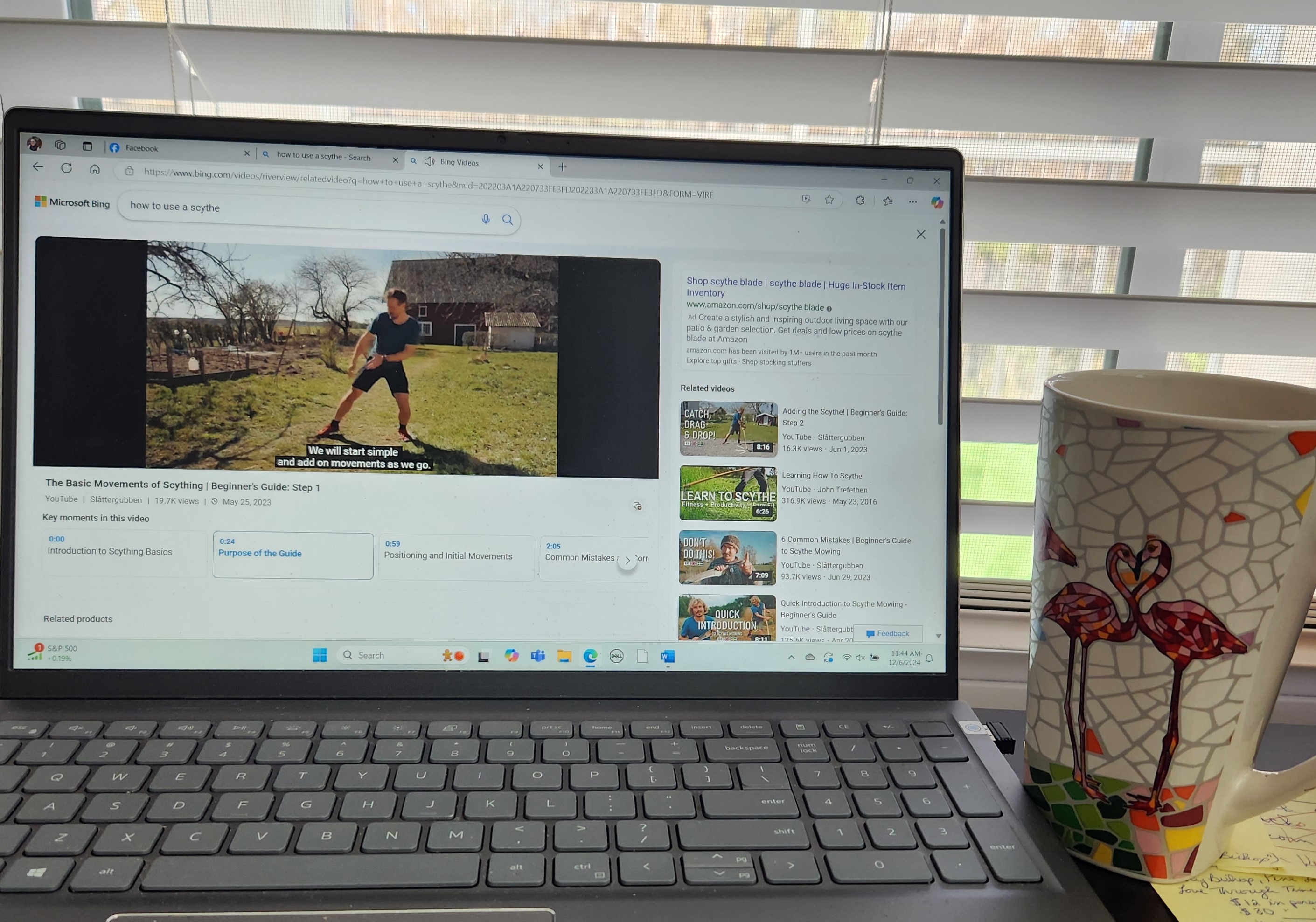
In working on “Under The Endless Sky”, about a girl homesteader in South Dakota, I found myself in need of a tutorial on how to swing a scythe. Thank you, YouTube.
I love small independent bookstores. Recently, I was in Galena, Illinois, for an annual book signing event (Romantic Galena Reads, next on 9/6/’25) and one of my obligatory stops was Galena Books & Paper at 306 S. Main Street. It’s not overly large, but it’s full of wonderful reads, both recent and older releases. Books for all ages. Cute notebooks and blank greeting cards. Not to mention, friendly owners and employees. I could spend hours browsing, but I’m afraid my credit card wouldn’t be able to handle the balance due. So, I limit myself, knowing I’ll be back again another day. This trip: one for me and two for my grandson.
Another small bookstore I look forward to checking out is Annette’s Book Nook in Santini Plaza, Fort Myers Beach. Annette’s store was destroyed during Hurricane Ian two years ago, but has been rebuilt and is currently being restocked. Annette’s another store owner who routinely supports local authors.
We’ve become so accustomed to the speed and convenience of the big online stores like Amazon, we have forgotten the joy of a leisurely browse through a brick-and-mortar storefront. Online you can quickly find a specific title and probably have it delivered direct to your door the next day. But you only see what you’re looking for, where in a storefront, you just might discover something new. Also, many of the small independents will give shelf space to local indie authors. Something big stores like Barnes & Noble, Walmart, and Target are unlikely to do.
Granted, online stores like Amazon have their place. I use them. Getting to a brick-and-mortar store isn’t always convenient, even possible for some. If you live in a rural area or small town far from a city, or perhaps have a health issue that prevents you from traveling, Amazon is a Godsend. But, when you do get the opportunity to go to a store where you can actually pick up the book, feel it in your hands, smell the freshly printed paper, peruse the neighboring titles, I suggest you take it. What a wonderful way to spend an afternoon.
When the afterglow of a new release has faded, there comes the inevitable decision of what to write next. It’s the time when you let go of all the questions and uncertainties of the previous book and begin planning your next. This is a time both exciting and frightening. Can I write another? What if that was my last? What if I have nothing left to tell?
What if this is the one where everyone realizes I’m a phony?
It’s called “imposter syndrome” and we all experience it at least once. Doesn’t matter if you have one published book behind you, or a hundred. I have five, and I feel that pit in my stomach every time.
Even the most experienced best seller, if honest, will admit they’ve felt that inkling of doubt. What can keep us typing might be the friends/readers/fans who repeatedly ask about the next one because they can’t wait. It’s reading the good reviews . . . and sometimes even the bad ones . . . that pokes us in the back to say: “sit down”, “start typing”, “show them you’ve got this”.
Some authors rarely look at their reviews, or refuse to read them at all. I’m one of those who check them fairly regularly. I recently saw that someone put a 3 out of 5-star rating on Amazon for my most recent release. No review, just 3 sad little stars. Instead of telling myself it means nothing, just one person’s opinion, I find myself worrying what it was that made them shave off those 2 stars. Everyone else gave me 5. But that’s just me. Instead, I’ll concentrate on all the good reviews, those readers who have told me in-person how much they enjoyed it.
Time to set aside the research for a while and start writing. “Under The Endless Sky” in 2025.
After the release of one book comes the exciting prospect of creating the next. So many questions to answer. Yes, it will be historical, but what year and where? Then there’s my characters. I need to know their backstories, even the details my readers will never know but I must because those shape who they are now. Then there’s their all-important names and goals, sorrows and joys.
I’m currently researching the story of women homesteaders in South Dakota in the early 20th century. It’s a story I’ve wanted to tell for years but wasn’t ready until I recently heard about a friend’s grandmother who did just that. It wasn’t only men who claimed their 160 acres from the Homestead Act of 1862. (Land was distributed through the Act from 1868 to 1955.) Women weren’t always dragged away from friends and family in the east to live a life of maddening isolation on the prairie, as was so often taught us in the past. Many women chose to embrace the challenge, the adventure. It was one of the few ways a woman could declare her freedom from men and own land of her own.
For women to do so, there were a couple of rules: She had to be either single or head of household. Meaning, if married, she needed to show her husband was unable to provide due to illness or injury. She could be a widow, and many were, bringing her children to work alongside her. The government didn’t want to give any of the limited available land to a woman with an able-bodied husband, and they didn’t want a wife to be able to claim the land neighboring her husband’s claim, thus giving them twice the allowed acreage. She had to be at least 21 years of age, same as the men. And, like the men, she had to be a citizen or an immigrant who had formally declared her desire to become a citizen. No one who fought against the Union was allowed to claim land. Free slaves could, allowing them the chance to start a new life.
Claiming your 160 acres was not free, and the work was not easy. You paid a locator to help you find available land that suited your needs, then paid a registration fee to the local land office. You had to build a structure to live in if you weren’t lucky enough to get land with one already there from someone who gave up their claim. Typically a dugout, soddy, or claim shack. Then you had to “prove up” the land over a course of five years. This meant an upfront investment in animals, equipment, and seed. Furniture and food for yourself until that first crop came in . . . if something didn’t happen to destroy it. If you weren’t blessed with a lot of money to invest, you had to find employment to work along with your claim. Some women taught school in their home. Others found jobs in town as a teacher, seamstress, waitress, or cook.
The prairie was a beautiful, but harsh, place to live. Extreme weather and constant wind. Insects, snakes, and other dangerous wildlife. Not to mention, you couldn’t always trust the other people. Especially if you were a woman living alone. But it was also a place of community. Neighbor helped neighbor. A woman homesteader might trade her bread baking skills to the man on the next claim if he’d plow her land for her. Some shared livestock and farming equipment. There were many social functions among the claims and in the towns to ward off the isolation. Holiday celebrations, Sunday afternoon card games. If someone had a guitar or violin or harmonica and could play a decent tune, dances were common. Some women brought pianos with them. Over time women formed sewing/quilting circles, literary and church societies. It was the women who made sure there were schools/teachers available for their children, as well as churches. (To civilize the men?)
Not everyone thrived in their endeavors. Crops failed. Homesteads burned in prairie fires or blew away in a tornado. Both man and beast froze to death when lost in a blizzard, or drown trying to cross a raging river. Death from illness or injury was common. But those that did succeed said later they would do it all over again. These people embodied the spirit that built this great country and it made them, all of us, stronger.
When the five years were complete, homesteaders were granted a deed declaring the land belonged to them free and clear. For the women, that meant their land would always be theirs, in their name, until they decided otherwise. For that reason, many of the women did not marry until after they’d “proved up” and claimed their land. At a time when women had very few rights, owning land gave them power. It was something no man could take away from them.
My next book, tentatively titled “Under The Endless Sky”, will be available in 2.
No matter how many books an author publishes, each new release is exciting. That’s how I feel now that my fifth novel, “Love Through Time”, has released. A romantic western time travel with a touch of paranormal, this story has something for everyone.
Annie March is devastated when she catches her fiancé in bed with another woman mere weeks before the wedding. But when she decides to go on the honeymoon without him and meets a handsome cowboy, a whole new world of possibilities opens before her.
Rancher Rod MacCray is attracted to the beautiful Annie from the moment they run into each other on a busy Deadwood street. But when he offers to take her to the ghost town of Custer Creek and show her the renovations he’s made to his four-times great-grandparents’ hotel, their lives are changed in a most unexpected way.
While in pursuit of a pair of ghosts, they fall through a broken staircase and wake up in 1880 Custer Creek running from an armed posse. Can they find their way back to their own time before Annie is hung for murders she did not commit?