 My next novel, “The Healing Heart”, is set in Wisconsin, 1918, against a backdrop of WWI and the Spanish Flu pandemic. My research of that time has been both fascinating and horrifying.
It came to be called the Spanish Flu because Spain was where all the initial cases were being reported. This led many to believe Spain was ground zero. Maybe it was, maybe it wasn’t, we don’t know. It was interesting to read that at the time the Spaniards called it the French Flu. The United States and allied countries had put a moratorium on negative press. All efforts, all funds, were put toward the war first. Any news that might frighten people and lower their morale was banned. So why was Spain free to report the rapidly spreading pandemic? Spain was neutral in WWI so there was no censorship of the press. But there were cases already occurring here and abroad.
The first wave struck the United States in February 1918, with initial cases being reported from Haskell County, Kansas. It’s believed that soldiers returning home on leave, or moving freely between camps, were bringing it with them. Soon twenty-four of the thirty-six largest army camps had the flu. Thirty of the fifty largest US cities, most adjacent to military facilities, reported an epidemic of flu cases by spring. The second wave, an “explosion”, hit nation-wide in September and continued through that winter. October was the worst. A third wave hit in December and lingered into spring, affecting many schoolchildren.
Symptoms were nosebleeds, coughing up blood, bleeding from the ears and eyes, coughing so hard it tore apart the abdominal muscles and rib cartilage, headaches that felt like someone was hammering a wedge into the skull behind the eyes, body aches like bones breaking, vomiting, skin color changing to anything from a light blue tinge around the lips and fingertips to a spreading blue so dark it looked black. Sufferers writhed in agony and delirium. It was a viral disease with no known cure other than time, rest, and prayer. It could kill in two ways: a quick and direct death with a violent viral pneumonia so damaging it was compared to burning the lungs; or more slowly and indirectly by stripping the body’s defenses, allowing bacterial pneumonia to invade the lungs.
Public gatherings were forbidden. Schools, churches, dance halls, movie theaters, bars and saloons, all closed. Posters warned against spitting, coughing, and sneezing. If even one member of a household was ill they were all put into quarantine; no one was allowed to enter except the physician, until at least four days passed without fever. Some communities allowed funerals with family only. Others, like Philadelphia, experienced such an overwhelming death toll that burials were in mass graves with no coffins. Steam shovels dug the pits. There were no funerals, no graveside mourners.
Not everyone contracted the flu. Not everyone who did ultimately died. In fact, despite the high death toll a majority of people survived. There’d been another flu pandemic back in 1889-90, with recurrences through 1894. A million people worldwide died in that one. Those who contracted and survived that strain were less likely to contract this one. And, like anything you might come in contact with today, some people had a natural immunity or were lucky enough to contract a weaker version and had the strength to pull themselves through with rest.
It’s estimated that as much as forty percent of the global population was infected over eighteen months. Anywhere from twenty to fifty million died worldwide. That’s more than the seventeen million killed in the war. President Wilson was struck down in April of 1919 while in France negotiating peace. He survived but his mind was affected; he became paranoid, erratic, and confused. Just four months later he suffered a stroke that may have been linked to the illness. His wasn’t the only report of lasting brain injury.
Not the kind of backdrop where you’d expect to find love, you say. I’d argue that love and happiness can be found anywhere; that it’s love that gets us through those hard times. It’s love that will keep Alice strong when tragedy and heartbreak threaten to crush her spirit.
Here’s a little ditty from 1918, a children’s skipping rhyme: “I had a little bird, and its name was Enza. I opened the window, and in-flu-Enza.” (author unknown)
 I’m ready to start my second novel. I want to start my second novel. Unfortunately, my brain doesn’t seem to want to go there. My heroine’s voice is not coming to me as easily as it did with the first novel and I realize that’s because Mary Bishop was older. She was a mature woman who knew her back story and could tell it to me with ease, even the most painful parts. I only had to lead her through her current story. But Alice is only eighteen and doesn’t have that more complicated back story. She’s led a quiet childhood with only her girlhood dreams to tell her what life is all about. She has her plans, but doesn’t know that those plans are about to be changed in a dramatic and, in some cases, tragic way. It’s up to me to tell her this and I’m not having much luck. So it’s time to shake things up.
 I’ve been spending time this week reviewing my notes from
  Life doesn’t always go the way we want it to, despite all our best laid plans and wishes. Sometimes life disappoints. This week I received my third rejection for my novel, “Mary Bishop”. They’ve all been encouraging; they’ve all spoken highly of my writing skills and research. The general consensus seems to be that it reads more like women’s or historical fiction with romantic overtones than a true “romance”. That’s all right. They’re not saying it’s a bad manuscript, just that I haven’t yet picked the perfect publishing fit. So, I have sent it out again. And after this, if necessary, I will send it out yet again. I will continue to resubmit it until I do find that perfect publishing house for me. It’s out there.
 While we might have trouble remembering the words to this traditional holiday song, we all recognize it when it plays and stumble as we try to sing along. The debate that rose at this year’s Christmas Eve party was just what does the song mean? Are the twelve days of the song leading up to or away from Christmas Day? That question got me thinking.
 Christmas is almost upon us and I’ve been busy baking cookies and making fudge. Sweets are a big part of Christmas, always have been. Who hasn’t read over and over, “Visions of sugar plums danced in their heads,” from Clement C. Moore’s poem “A Visit From St. Nicholas” published in 1823? (Better known today as “Twas The Night Before Christmas”.) And there’s the beautiful dance of the Sugar Plum Fairies in Tchaikovsky’s ballet “The Nutcracker” composed in 1892. While not as popular as they once were, sugar plums can still be purchased online.
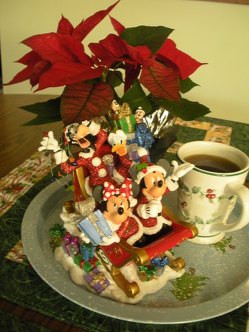 I love poinsettias. Red, green, or white, it doesn’t matter; although I do prefer the red. This year I have a small red one as a center piece on the dining room table, as well as a large floor plant.
 Christmas is a time of traditions. As I decorate our home this week I am reminded of one many of you have probably never heard of: the Christmas Pickle. The story is that this is an old German custom. You hang a glass ornament shaped like a pickle on the tree and the first child to find it gets an extra present. In our case it was something small, like a bag of M&M’s. If parents couldn’t afford to purchase an extra gift, that child was allowed to open presents first.
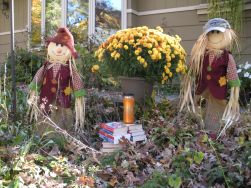 For my final Giving Thanks blog I have to say I am thankful for my family; not only the family that shares my DNA, but the family I married into, my church family, my writer family, my work family, my community family, etc. We are all family, and that means we don’t always get along. But that doesn’t mean I’m not thankful that they are in my life because even the negative can have a positive effect. We learn from our negative experiences, at least we do after we stop crying and complaining and asking everyone why so-and-so is so mean. Just as our own mistakes can teach us why we don’t want to do that again, other people’s mistakes can teach us why we won’t want to do that ourselves.
 Jane Yunker, Author