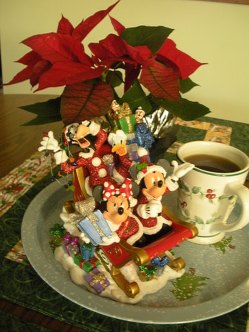
 I love poinsettias. Red, green, or white, it doesn’t matter; although I do prefer the red. This year I have a small red one as a center piece on the dining room table, as well as a large floor plant.
Poinsettias are not native to the United States, but originate in southern Mexico and Central America where they “flower” in the winter. Actually, they aren’t flowers at all, but special leaves called bracts. The Aztecs called the plant cuetlaxochitl and used the flowers to make purple dye for cloth and cosmetics. They made fever medicine from the milky white sap we know as latex.
Joel Roberts Poinsett is credited for originally bringing poinsettias to the United States in 1828. Poinsett was appointed the first US ambassador to Mexico in 1825 and shipped the plant back to his plantation greenhouses in South Carolina where he began growing the plants and sending them to friends and botanical gardens as gifts.
One of those friends, John Barroom of Philadelphia, gave a plant to his friend, Robert Buist. Buist sold the plant under its botanical or Latin name, Euphorbia pulcherrima, which means, “the most beautiful Euphorbia”. Once it became known in the mid-1830s that Ambassador Poinsett was the one to introduce the plant to the country, people began referring to it as a poinsettia.
One version of how poinsettias became linked with Christmas can be told through an old Mexican legend: “There was once a poor Mexican girl called Pepita who had no present to give the baby Jesus at the Christmas Eve Services. As Pepita walked to the chapel, sadly, her cousin Pedro tried to cheer her up. ‘Pepita,’ he said. ‘I’m sure that even the smallest gift, given by someone who loves him, will make Jesus happy.’ Pepita didn’t know what she could give, so she picked a small handful of weeds from the roadside and made them into a small bouquet. She felt embarrassed because she could only give this small present to Jesus. As she walked through the chapel to the altar, she remembered what Pedro had said. She began to feel better, knelt down and put the bouquet at the bottom of the nativity scene. Suddenly, the bouquet of weeds burst into bright red flowers, and everyone who saw them were sure they had seen a miracle. From that day on, the bright red flowers were known as the ‘Flores de Noche Buena’, or ‘Flowers of the Holy Night’.”
Another interpretation, one I’ve heard many times over the years, is this: the shape of the flower represents the Star of Bethlehem, the red color the blood of Christ, and the white leaves purity.
For more fun facts on Christmas traditions, go to www.whychristmas.com/customs.
 Christmas is a time of traditions. As I decorate our home this week I am reminded of one many of you have probably never heard of: the Christmas Pickle. The story is that this is an old German custom. You hang a glass ornament shaped like a pickle on the tree and the first child to find it gets an extra present. In our case it was something small, like a bag of M&M’s. If parents couldn’t afford to purchase an extra gift, that child was allowed to open presents first.
 Thanksgiving is over and now begins the mad rush to Christmas. What we need to remind ourselves when the planning and gift shopping panic sets in, when the constant countdown reminders begin to haunt us, is that this is not what Christmas is all about. For those of us who profess to be Christians, Christmas is still, at its very core, about the birth of Jesus Christ. But, for all of us, no matter what we believe, Christmas is about gathering with our friends and families to laugh, sing, possibly drink too much, and definitely once more eat too much before embarking on our annual diet pledge.
 For my final Giving Thanks blog I have to say I am thankful for my family; not only the family that shares my DNA, but the family I married into, my church family, my writer family, my work family, my community family, etc. We are all family, and that means we don’t always get along. But that doesn’t mean I’m not thankful that they are in my life because even the negative can have a positive effect. We learn from our negative experiences, at least we do after we stop crying and complaining and asking everyone why so-and-so is so mean. Just as our own mistakes can teach us why we don’t want to do that again, other people’s mistakes can teach us why we won’t want to do that ourselves.
 This week’s Giving Thanks is an easy one. I’m thankful for my writing community. Some are friends I’ve known personally for years, while others are just names and small pics in a Facebook group. But I credit all of them for keeping me going and getting me to where I am today: a completed novel requested and right now being read by two different publishers.
 It’s during the holiday season that we come to truly appreciate, and rely on, family traditions. One I’ve become very close to since we’ve been back in Wisconsin is “lefse day”. It’s that Tuesday in early November when I get together with my sister-in-law, Sue, and we spend the day making lefse. For you unfortunates not familiar with this treat, lefse is a traditional Norwegian flatbread made from potatoes, flour, sugar, salt, and butter. It’s my job to roll puck-sized pieces of dough into rounds so thin you can just start to see through them, then Sue cooks them on a special griddle. And they are delicious! Doesn’t matter if you like them with butter, butter and sugar, jam, or cream cheese; they are a treat. Eaten mostly around the holidays, we freeze them to enjoy year round.
 What makes this a wonderful tradition and not just a chore is the social side of lefse-making. Sue arrives about 9:30 and after the loaves are formed and put into the refrigerator to set, we will have at least an hour of visiting over coffee and fresh baked goods. We remember past years by revisiting the journal we keep with the recipe: date, sunny vs cloudy, air temperature, snow or no snow, who stopped by, how many loaves we made and how many pieces we ended up with, any special event. Then we start the journal entry for that year.
 Halloween is over and November is here. We’re rushing head first into the holiday season and Thanksgiving is only three weeks away. For the month of November I’ll be blogging about the things I’m thankful for and I encourage my readers to comment, to share the things for which they give thanks. All I ask is that you keep it clean.

 What does love look like? While love is different for all of us and can change based on the moment, we can still recognize it when we see it for someone else.


