 Winter isn’t done, but spring is definitely just around the corner. For the last week we’ve had mild temps in the 50s, even the low 60s. The snow is gone, except for the banks left by the plows. The smell of wet earth promises flowers soon. The first round of maple sapping was under way this past weekend. There have even been bear sightings.
Hope and promise is on the breeze. I can smell it. I can feel it. I can almost taste it. The sun is warm even when the breeze is cool and it’s still light out when I drive home from work. The greens and fairways are clear on the golf course.
Now, before you shake your heads and sigh at my naiveté, I have not forgotten it’s still only February. I’m a born and bred Wisconsinite. I know that even if spring happens to come early this year, that won’t mean winter is over. We can snow in May, although thankfully not very often! In fact, by the time you read this we might be in the grips of a blizzard. The predictions range from 8-12 inches to a dusting-3 inches by the end of Friday! What? I know, it’s crazy but that’s how the weather goes around here. Will the storm stay on its original tract or will it move south? Local meteorologists are now saying the storm has moved dramatically south and we’re on the northern edge. We won’t know who’s right until the sun comes up in the morning. But, no matter what, we will get some snow.
Well, I say if winter has to have one last (fingers crossed) blast, make it a big one. A really big one! Make it a blizzard where you can’t see two feet outside your windows and you have no choice but to stay indoors. I won’t feel guilty telling my boss I can’t get out of my driveway if I can’t even SEE my driveway. (In truth, I’m part time and have already been told to not come in tomorrow because even a dusting could make my commute slippery, so no guilt either way.) And, what better timing for a snow day than a Friday? There will be no rush to get out the next morning, either. It can be a stay in my pajamas, watch movies, read, and write kind of day.
This week’s blog, like our first taste of spring, is brief; and, like spring, I will return.
 This week was Valentine’s Day. That one day a year that brings to mind roses, chocolates, wine and a special dinner out. The day when the one who loves you most is supposed to do something extra to let you know, and vice versa.
 We live in a fast-paced world where everything is tightly scheduled and there is no room for deviation. Children no longer go outside to play after school or on the weekend. They are too busy being chauffeured to their various sports activities, music lessons, and the tutoring that will hopefully get them into a better university after graduation. Even pre-schoolers have scheduled “play dates”. No one sits on their front porch anymore, waving to their neighbors as they walk by, inviting them to stop and chat over a cold drink. Most don’t even know their neighbors’ names. Children no longer play kick-the-can in the growing darkness until their mothers holler out the back door that it’s time to come in. Dad’s in one room reviewing departmental reports while mom is in another preparing for her big morning presentation in front of the Board. Meanwhile, if by chance the children are actually done with their homework, they are on their computers either perusing their social media accounts or deep into a multi-player video game, stopping only long enough to answer a text from their friend who probably lives right next door or across the street. None of them, parents included, can even sit down for a family meal together without their cell phones right there within easy reach. Ask them an hour later what they had for dinner and I’d wager a bet most of them couldn’t tell you. Did they even taste it? We live in a world of texts written in indecipherable shorthand, tweets of 140 characters or less, and emojis.
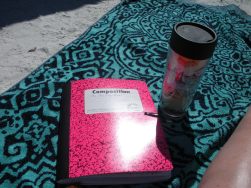 Two weeks ago I wrote about my plans to “shake things up”. Well, this was the week and I’m calling it a complete success! I’ve spent the last three days on Ft Myers Beach, just me and my notebook on the beautiful Gulf shore with hundreds of my closest friends. . .but that added to my success. I sat in the warm sand and listened to the surf and the gulls; watched small children play in the water (LOL), retired couples walk hand-in-hand (smile), and parasailers soar overhead (bucket list!); and I wrote. I wrote and I wrote. Drafting in long-hand, as hoped, opened up my creativity. I wasn’t tempted to go back and edit, the way I am when I’m on the computer. I wasn’t confined to writing where there was an electrical outlet and no damaging sand and water. And note paper doesn’t have that sun glare problem! I could go anywhere. I wrote on the beach and poolside. I wrote in my room. I wrote sitting at an outside table of a little Greek restaurant while enjoying one of their delicious gyros. My notebook and pen went in my beach tote every morning and followed wherever my wondering feet led me. When I was inspired, when a plot question resolved itself in my mind, all I had to do was find a place to sit and write.
 Each of those three days I wrote one chapter. Today I will write a fourth and tomorrow a fifth. I estimate a total of 40-50 pages completed by the end of my trip. To some writers that might be a set-back, but for me it was very productive. After all, I needed to leave time to walk, shop, and read; time to allow the tropical sunshine to recharge my half-frozen northern brain.
 My next novel, “The Healing Heart”, is set in Wisconsin, 1918, against a backdrop of WWI and the Spanish Flu pandemic. My research of that time has been both fascinating and horrifying.
 I’m ready to start my second novel. I want to start my second novel. Unfortunately, my brain doesn’t seem to want to go there. My heroine’s voice is not coming to me as easily as it did with the first novel and I realize that’s because Mary Bishop was older. She was a mature woman who knew her back story and could tell it to me with ease, even the most painful parts. I only had to lead her through her current story. But Alice is only eighteen and doesn’t have that more complicated back story. She’s led a quiet childhood with only her girlhood dreams to tell her what life is all about. She has her plans, but doesn’t know that those plans are about to be changed in a dramatic and, in some cases, tragic way. It’s up to me to tell her this and I’m not having much luck. So it’s time to shake things up.
 I’ve been spending time this week reviewing my notes from
  Life doesn’t always go the way we want it to, despite all our best laid plans and wishes. Sometimes life disappoints. This week I received my third rejection for my novel, “Mary Bishop”. They’ve all been encouraging; they’ve all spoken highly of my writing skills and research. The general consensus seems to be that it reads more like women’s or historical fiction with romantic overtones than a true “romance”. That’s all right. They’re not saying it’s a bad manuscript, just that I haven’t yet picked the perfect publishing fit. So, I have sent it out again. And after this, if necessary, I will send it out yet again. I will continue to resubmit it until I do find that perfect publishing house for me. It’s out there.
 While we might have trouble remembering the words to this traditional holiday song, we all recognize it when it plays and stumble as we try to sing along. The debate that rose at this year’s Christmas Eve party was just what does the song mean? Are the twelve days of the song leading up to or away from Christmas Day? That question got me thinking.
 Christmas is almost upon us and I’ve been busy baking cookies and making fudge. Sweets are a big part of Christmas, always have been. Who hasn’t read over and over, “Visions of sugar plums danced in their heads,” from Clement C. Moore’s poem “A Visit From St. Nicholas” published in 1823? (Better known today as “Twas The Night Before Christmas”.) And there’s the beautiful dance of the Sugar Plum Fairies in Tchaikovsky’s ballet “The Nutcracker” composed in 1892. While not as popular as they once were, sugar plums can still be purchased online.
