Morning Coffee: Take A Step Back

056Sometimes the best thing we can do for our writing is to not write. You heard me. Stop writing! Instead, turn your thoughts to something else for a while. Read a book. Go fishing, to the beach, for a walk. Do anything else. Think about anything other than your work-in-progress. It could be for just a day, or for a week, or maybe an extended vacation where you don’t have your computer or your manuscript anywhere nearby. You’ll come back with a clearer vision of what you’ve written.

That’s what I’ve done. While in Canada fishing I did take a couple hours mid-week to make revisions to my last chapter. It was a rainy day and the others wanted to go out anyway but I wasn’t that enthused that I was willing to sit in the rain, so I took a day off from fishing to finish the rewrite of my novel I’d been working on for so long. I wanted to have that step done while I still had the momentum of my changes pushing my brain along. But then I set it aside and for about a week and a half I didn’t touch it; didn’t open the computer file or the binder with my hard copy. I tried not to think about it but that was a little more difficult. I knew I wanted to have one more go-through but I wanted to do it with fresh eyes.

035You see, our eyes read what they expect to see so we miss typos, read right over where we’ve switched point of view or used the wrong character’s name. (It took a friend’s read to point out to me I’d used my heroine’s dead husband’s name in place of her new love’s. Yikes! No, Earl had not been visiting Mary. This is not a paranormal romance.) We become so in love with our own writing abilities that our “baby” still looks beautiful to us even though she’s been playing in the mud all day and needs a good scrubbing, clean clothes, and maybe even a haircut.

So I opened that binder with red pen in hand. I’m reading “Mary Bishop” the way my readers will, on paper. (Except for the red pen, I hope.) I’m reading from start to finish and I won’t open the computer file until I’m done. You see, the words look different on paper than on the computer screen. They look “fresh”. When I was slowly creating it chapter by chapter I didn’t get to experience the story as a whole. Now I’m listening to Mary tell her story uninterrupted and, yes, even though this is not my first revision, I’ve found a few more typos.

DSCN2799Stop writing! I say it again. Take a break. Rejoin the real world of real people and real summer sunshine. Then, when you do go back to your writing, you’ll have a clearer picture of whether or not it really says what you want it to say. Take an example from this seagull. He just feasted on the leavings from our shore lunch and now he’s just floating along enjoying the afternoon. He’s not worried at all whether or not he remembered to fact-check that important historic detail.
Morning Coffee: Fishing for Ideas

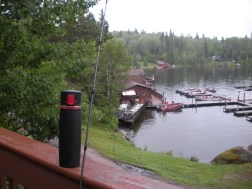
003I spent last week at Stanley’s Resort on Eagle Lake near Vermilion Bay, Ontario, some of the most beautiful country I’ve seen and a marvelous staff. I was there with my husband, brother-in-law and his wife learning to fish and I couldn’t help but be struck by how much fishing is like writing.

Casting for fish is like casting for ideas, or that perfect word. You throw your line into the water and hope for a bite. Sometimes they strike immediately, but most of the time you have to sit and wait and then troll to another location where you might have better luck. In the meantime, you sit quietly watching the shoreline, listening to the song birds and the call of the loons as your muse, your heart jumping with hope at every little tug or catch on the bottom.

069

Most of the time your catch will go right back into the water as either too big or too small, that illusive, manageable middle ground hiding back in the weeds. Even the keepers can be hard to pull into the boat, fighting your efforts to control them the entire time. But when that perfect catch does break the surface you know it! You tease it; chase it back and forth until you get that first glimpse of it flashing in all its glory in the sun and you know it’s the one you’ve been searching for so long and so patiently. (Or, not so patiently!)

And at the end of the day you sit around with your friends and a cooler full of beer and talk about the ones that got away. The ones that just didn’t quite stay on the line and reel in the way you would have liked, despite your best efforts.

Here’s a picture of my biggest catch of the week, a 40 inch northern made possible by our guide, John, in the background. Yes, it was too big and had to be thrown back, but it makes for a heck of a “fish story”.

062

Morning Coffee: While I’m Away

Summer


By the time you’re reading this I will be in Canada fishing…and writing, of course. So, while I’m away, I’ll leave you with some of my poetry. I hope you enjoy and I’ll see you back here next week.

June Bugs by Jane Yunker

Fat bodies hurled
against bedroom windows
attracted by the light.

Shells click
frenzied thumps
wings buzz desperation.

Do they want to read over my shoulder
or are they just afraid of the dark?

After The Rain by Jane Yunker

Past dirty ankles the water rushed
tumbling the dam of leaves and sticks
built so carefully by muddy fingers
to stop the dreaded pirate ship
from plummeting down the sewer.

************

An earlier version of “June Bugs” appeared in the Summer 2013 issue of Creative Wisconsin, published by the Wisconsin Writers Association.

“After The Rain” appeared in The Villager, Oct 1985, and Priority Parenting, July 1992.

Morning Coffee: Baggage

SummerWe all come with baggage. It starts collecting from the moment we are conceived and doesn’t end until the day we die. It’s what we do with that baggage that builds our character, the ever-changing person we become.
We are born with a coin purse full of the beginning events that shape us both physically and mentally: perhaps mom smoked while pregnant, or had a few too many glasses of wine. She may have been in a car accident or had health problems that risked our own well-being when we were at our most vulnerable. There’s our very DNA, the building blocks that not only determine what we look like, but whether or not we will one day fall victim to certain diseases.

As we get older there are the teachers who inspire us and the athletic coaches who terrorize us…or, for some, it’s the other way around. There are best friends and neighborhood bullies. We earn recognition for our accomplishments, are given raises and promotions, awards. We are laid off, or just plain fired, from a job we loved, or perhaps forced to stay in a job we hate. There are injuries, illnesses, and deaths.

Events totally out of our control will change the way we perceive our world, our safety. There are hurricanes, tornados, fires, droughts, and wars. Who wasn’t affected by the events of September 11th? Everything we do now, all the precautions, the long lines at the airport and the travel warnings, perhaps even the way we look at others around us, goes back to that horrible day.

We get married, have children, and maybe end up divorced. Or we might never find that right person and remain single all our lives. There are many couples who desperately want children but find they can’t conceive, and children who desperately want “forever” parents but grow up without.

We all come with baggage, both good and bad. We start with that little coin purse and we end with a trunk-full. What do you do with all those experiences? Do you focus on the horrible, the unfair, until your trunk becomes so heavy you are completely weighed down by it? Or do you push aside the bad and focus on the good so that your trunk goes almost unnoticed? I’d argue most of us fall somewhere in-between, and it depends on the day. Some days it feels like you just can’t win and others you’re on top of the world.

I had one of those extra good days recently. The final judging results for WisRWA’s 2016 FabFive competition were announced and my book Mary Bishop ended in fourth place in the historical category out of twenty two initial entries. I will hear soon whether either of the final judges, an editor and an agent in the historical romance industry, want to read more, but even if they don’t, in my mind it’s still a win.

Morning Coffee: Love and Romance

Mothers Day 1First love. Young love. Puppy love. True love. Second chance at love. Love makes the world go round. Whatever you call it, we are all in love with love.

From the day we are born we look for love, we give and we long to receive. We love our parents. We love our teachers, our best friends, that boy (or girl) who sits across the aisle from us in class. It’s why the romance industry is thriving. We buy chocolates, flowers, cards, rings to demonstrate just how much we love someone. There are entire cable television channels dedicated to romance! And we love to read a good romance novel.

The Romance Writers of America (RWA) sites 2013 statistics of over $1 Billion in sales a year; 32% of mass market paperback sales are romance novels. Not surprisingly, 84% of romance readers are female; yet, surprisingly (to me) 16% of romance readers are male. Let’s face it, we all love a happy ending and romance novels are all about happy endings.

I continue to work on my revisions for Mary Bishop. I’m working on the last chapters, expanding on the plot line that threatens to keep Mary and Oliver apart. I get the thrill of writing my happily-ever-after ending all over again. It’s a second chance at love for both, something neither one of them ever expected, and I’m just as excited about it as I was the first time I wrote it.

At the same time, I’m anxious to get started on my next project, The Healing Heart. A young girl finds love during WWI and the great influenza pandemic of 1918…but more on that later.

I’ve been debating which romance to read next. It’s not as easy of a decision as you might think. So much depends on what kind of a mood I’m in. Historical or contemporary? Usually historical. Then, which historical era? There’s a lot of history to consider. Then there’s theme. Am I thinking suspense, political drama, big city or small town? The choices are endless and I’ve been known to change my mind multiple times before I actually start reading, but I think I’ve made my choice. Diana Gabaldon’s Outlander has been on my Kindle for some time and I feel the draw to read it next. And after reading it I will put the Starz network series on my Netflix list and watch that.

Morning Coffee: Memories

Mothers Day 1The senses can bring back a flood of memories. I seem to be particularly susceptible to this in the summer. The distant whine of a lawn mower and, with it, the smell of fresh cut grass. The clean tang in the air after the rain has passed by. The song of the morning dove outside my bedroom window.  The announcer and cheering crowds of the softball games at the nearby school athletic fields reminds me of the sounds of the public swimming pool in my hometown. When I think of summer, I think of the feel of the rubber grip of a golf club in my hands as I focus on that little pink ball taunting me from the grass below. When I think of summer I immediately taste buttery corn on the cob, salted tomato slices fresh from the garden, strawberry shortcake and watermelon. I remember the Fireman’s Picnic, parades, and days at the lake.

One of my strongest childhood summer memories is that of hanging wash on the line to dry. You don’t see that much anymore, even in the small towns. If you want to see clothes flapping in the wind to dry you need to drive the back country roads, past the mid-west farms where many such things are still done the traditional way. Admit it, there’s nothing like the feel and smell of fresh sheets still warm from the sun.

The following poem originally appeared in the Wisconsin Writers’ Association publication, Creative Wisconsin in the summer of 2012.

Hanging Wash On The Line
by Jane Yunker

Wet towels flap, snap, in the hot summer wind.
My mother hums a nameless tune as she carefully
pins them, ends overlapping ends to conserve space,
for row after row to bake in the sun until dry.

My mother has strict rules for hanging wash on the line.
Rules passed down from her mother, and now to me, a code.
Rules my own daughter would only laugh at, if I told her.
Rules that, if broken, would surely incite gossip and shame.

Hang clothing of like sex together.
Never should my father’s underwear hang co-mingled
with my mother’s, nor my brothers’ with my own.
What such a display might suggest was beyond decent explanation.

Hang clothing of like type and size together.
Men’s socks hung neatly from largest to smallest,
pairs matched, of course. Women’s follow, in same.
This orderliness outdoors was proof of a neat orderly home indoors.

Shirts were hung from the bottom, while pants hung from the top.
And, never, not under any circumstances, do you drape…you pin.
We are civilized beings lucky enough to be born in America,
a nation blessed with basic necessities like the clothespin.

But the one rule that, if forgotten, could drive a family from their home,
was to hang all intimate apparel on the inside lines and surround them
with large items to block their view, preferably sheets and towels.
The neighbors should only assume one wears underwear.


Morning Coffee: Family

001Family. Narrowly defined it’s two parents and their biological children; extended it includes grandparents, aunts, uncles, and cousins. Now the definition has become much more fluid. The parents could be two men or two women, might be married but could also be living together without the benefit of marriage. A parent might not be biological. A child could easily have more than two parents once you count in the step parents after divorce and remarriage. They could be foster parents or adoptive parents.

Family. Often we think of our pets as family. Many would argue pets are much more reliable, much more loyal, to us than our human family. Pets won’t fight over who gets grandma’s jewelry or the profits from the sale of great-auntie’s house. If a dog gets his feelings hurt all you have to do is smile at him and scratch behind his ears and all is forgiven. When you walk in the door after a hard day’s work, your cat will curl up in your lap and your dog will just about knock you over at the door with happiness. Neither one comes running to tattle on the other.

Family. It’s said our friends are the family we get to choose. In my book Mary Bishop, Mary is alone after the Civil War has decimated the home, the life, she once knew. Her daughter died shortly after birth, her son died at Gettysburg, and her husband later commits suicide. She reaches out to an old friend, Sarah, from her life back in Virginia. She doesn’t know if Sarah is alive or dead, but she has an address where her friend once lived. To Mary’s delight, Sarah still lives at that old address and doesn’t hesitate to drop everything and run to Mary’s side. It’s a long and difficult journey (train from St Paul to Stillwater, steamboat upriver from Stillwater to Taylors Falls, and then a ride with a travelling minister north from Taylors Falls) but she does this without being asked. “Why?” Mary asks. Why is her friend doing everything she can to make her old friend happy again? “Because we are family,” Sarah answers. Something Mary told Sarah years before when Sarah’s husband was killed and Mary refused to leave her side until Sarah could pick herself up again.

Family. These are the people who are there for us no matter what. They might judge us, but only lovingly. They defend us against those who would tear us down. They will sit with us and just listen, all night if need be. They might be biological, they might be steps or halves, or they might be a very good friend.

Morning Coffee: The Power of Solitude

Mothers Day 1Have you ever just sat alone and listened to the world around you? Even in the middle of the night, when everyone is asleep and we think it’s perfectly quiet, it’s not. The house makes little noises as it settles, beams expanding or contracting with the changing temperature, creaking and snapping. Outside tree limbs brush against the house as the wind tosses them, not always so gently. There could be the distant rumble of an approaching storm, or the forlorn wail of a train whistle.

On an early spring evening I can hear the peeper frogs singing in our garden as they look to attract a mate. Come summer, there’s the deep-throated croak of a toad and the chirps of crickets rubbing their legs together in the long grass along the neighboring woods. I can even hear the trucks passing by town on the highway. A heavier footfall in the woods leaves me to wonder, is that a deer, or a bear? I know there are bears in our woods and they like to wander into the neighborhood to raid bird feeders and garbage cans.

These night time sounds can be restful, like the patter of rain on the sky lights of our bedroom and on the leaves of the trees outside. Or, they can be scary, particularly if I’ve spent the evening before watching horror movies. But I tell myself, I am no longer a pretty young co-ed, and I would never dream of investigating a noise in the basement while wearing only my underwear, so I’m probably safe. (For the same reason I’d change from my red uniform shirt to my yellow if Captain Kirk ever asked me to beam down to the planet surface with the away team.) At worst, the noise I think I hear within the house is a mouse and it will soon find its way onto one of the sticky traps set out for that very purpose.

Solitude recharges our batteries. If you concentrate on each little sound and not let the worries of the day intrude, you will feel your heart rate slow, your muscles relax. And if you’re a writer, you might even be able to hear your character’s voice telling you the answer to the plot problem that’s been troubling you all day.

Listen to the silence.

Morning Coffee: Mother’s Day

Mothers Day 1Mothers. We all have one. Most often it’s the woman who gave birth to you, but it might not be. It could be the woman who fostered or adopted you. It could be the aunt or grandmother who raised you when your biological mother could not. Some children have two mothers. Whoever you call your mother, this Sunday is the day set aside to honor her for her love and sacrifices. Of course, we should honor our mothers every minute of every day if only in the simple things like a kiss and I love you when you leave for school in the morning or go to bed at night. Or perhaps by offering to wash the dishes after dinner without having to be asked. How about cleaning your room merely because it’s messy.

While celebrated world-wide, the tradition of setting aside a day to honor our mothers began officially in the United States in 1914 when President Woodrow Wilson signed a measure setting aside the second Sunday in May. Anna Jarvis created the idea for the holiday in 1908 but would later denounce the commercialization of the holiday and spend the rest of her life campaigning to have it removed from the calendar. Her vision was one of a personal holiday between a mother and her family, one where you would wear a white carnation as a badge, visit your mother, and attend church as a family.

It’s a day traditionally celebrated with cards, gifts, flowers, and a family dinner mother presumably does not have to cook or clean up after. Teachers lead school children in the creation of macaroni artwork and hand prints in paint or plaster to bring home to their mother. Some mothers are served a lovingly prepared breakfast in bed of orange juice, cereal with too much milk and sugar, and heavily-buttered burnt toast. If dad helps, breakfast might include a much appreciated cup of coffee to wash it all down.

When my children were small, I remember getting tiny bouquets of violets or dandelions clutched tight in their sweaty little hands and presented with a big smile. Hand-drawn I love you Mommy cards and dandelion bouquets were some of my best Mothers Day gifts. Not to say I don’t appreciate the grown-up gifts of chocolates, wine, spa baskets, books, and the like delivered by post and followed by the I love you Mom phone calls.

Being a mother has been the hardest, and most rewarding, job I’ve ever had to do in my life. It’s made me realize just how much my own mother had to do, had to give up, over the years to raise five children. I was not always perfect, and there may have been times they wished they could fire me and hire someone else, but in the end I have two wonderful happy adult children successful in their jobs and NOT living at home.

Whether you are lucky enough to still have your mother, as I am, or whether your mother has since passed on from this world, take time on Sunday to remember all the wonderful things your mother did for you over the years. Forget any petty arguments or ill-will you may still harbor and give her a call to say I love you, Mom, and I appreciate all the things you’ve done for me.

I love you, Mom, and I appreciate all the things you’ve done for me.

Morning Coffee: Friends

Revisions“Make new friends but keep the old, one is silver and the other gold.” Remember that song from Girl Scouts? At least, that’s where I learned it. It made for a great campfire round, but is there any truth to it? Are old friends better than new ones? Or, for that matter, are new friends better than old?

I’ve lost track of some of my oldest friends, the ones that go back to childhood. Some I know where they are but we don’t talk anymore, and some I have no idea where they are now. The beauty of Facebook has been the ability to reconnect with old friends. I’ve “friended” old classmates I would not have necessarily considered a “friend” back then, but that I do now. Does that make them a new friend, or an unrecognized old friend?

Then there are my somewhat old friends, the people I grew close to when living in western New York State for 30 years. Between Facebook and email and ever expanding/improving cell plans they’re easy to keep in touch with…although, even then we’re not always good at it.

Now I’m making new friends here in northwest Wisconsin. Some are neighbors, some fellow church members, co-workers, and many are also writers. I’d have a hard time if required to label some of them as “gold” and some of them as “silver”, especially if based solely on how long I’ve known them. My friends are my friends and I hold them all equally close to my heart.

Mary, the heroine in my novel Mary Bishop, is struggling with feeling alone now that her husband has died. She has formed a friendship with the minister’s new young wife, Frances, but mourns the loss of her friends from her past in Virginia. Some died during the War, while others moved on after the fighting ended and she no longer knows where they are, or if they even still live. But there is one, her friend Sarah, who did keep in touch after moving west. Mary wonders why they eventually stopped writing, and is her friend still living in Minnesota? She writes Sarah in hopes of finding her old friend. She thinks her old friend will be the answer to her problems, more so than her new friend. Does that make Sarah a “gold” friend and Frances a “silver” friend? Especially once she finds out the role Frances played in bringing the two back together.

Perhaps the label of “gold” or “silver” changes with the moment. Perhaps which is your answer depends on what is your question.