 Years ago my mother gave me a blank book entitled “Some Incredibly Important Trivia”. I use it to record sayings that move me, whether funny or thought provoking, it doesn’t matter. My most recent entry is by Eleanor Roosevelt:
“Do what you feel in your heart to be right, for you’ll be criticized anyway.”
I’m often asked if what I’m writing is true. Did that happen to me? To someone I know? You can see the sparkle in their eyes as they anticipate some juicy gossip, or the fear that I might be writing about them. Yes, I’m inspired by life around me, maybe something I overheard or saw in passing made me think beyond the actual event and off into the land of what ifs, but I’m not writing anything specific. My life is not that exciting and I’m not so callous as to out a friend in such a public manner. I’ll leave that kind of reporting to The National Enquirer. So relax and set aside that race to judgment.
I can’t be concerned with what others might be thinking about my writing. I can’t question whether or not they will approve of how I choose to tell my story. If I were to put that kind of scrutiny on myself I’d never get anything written.
Nor can I be concerned about what people might be thinking about me based on my characters, or the genre I choose to write. There are people who actually think romance novels are trashy, a waste of time and money. I’ve been told I should write something literary, something great, something that will last for the ages. . .not something that “smacks of money”. That’s right, someone actually accused me once of writing for money, said by doing so I was selling out! (This was in reference to my poetry.) My obvious reply to this person was yes, I write for money. Of course I hope it will be great and stand the test of time; but yes, I also write with the goal of getting paid.
If your writing is a means to a higher purpose and getting paid holds no importance to you, then that’s what you should do. I can only do what feels right to me, be true to my own heart. It’s why I was disappointed when my first submission of “Mary Bishop” was quickly rejected as not suited to their current needs. It’s also why I turned around and sent it right back out to someone else. I will do this over and over until I find that perfect fit, that publisher who is as excited about my book as I am. As for those who choose to criticize me, I choose to ignore them.
 It’s one of those words we use to qualify everything, diminish the meaning of whatever we’re talking about. “I was just saying.” “It was just a little dent.” “I’m just a housewife” or “a secretary” or “a romance writer.” We say it all the time without thinking about it. It rarely serves any true purpose other than to make less of something, often ourselves. We make ourselves a little smaller every time we say, or think, it.
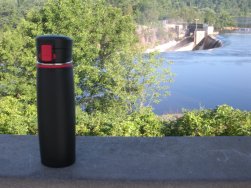
 I have the great fortune of living along the Wisconsin shore of the powerful and beautiful St. Croix River. Approximately 169 miles of waterway runs through the states of Wisconsin and Minnesota, the lower 125 miles forming the border between the two states, until it reaches its mouth at the Mississippi River.
 with cameras to view the impressive cliffs and colorful fall leaves while eagles soar over their heads. Recent heavy storms to the north dumped as much as ten inches of rain, sending a torrent of muddy floodwaters downriver. Roads were washed away; some bridges had to be closed. Scores of people flock daily to the overlooks to experience the power of the river. Sluices on both sides of the dam are full open to help control the tremendous amount of water that is currently rushing over the top of the dam.
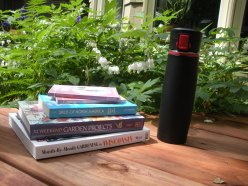
 I’m sitting at my desk, sliding door to the deck open. It’s a beautiful summer afternoon. The sun goes in and out from under gray clouds that tease us with the possibility of rain later this evening while throwing long shadows across the yard as the afternoon wears on. I don’t have to work today and I’ve done enough housework to quell any feelings of guilt so now I’m enjoying the down time while revising the final chapters of “Mary Bishop”.
 Benjamin Franklin said, “He that can have patience can have what he will.” He also said, “Motivation is when your dreams put on work clothes.” How very true for the writer.
 Sometimes the best thing we can do for our writing is to not write. You heard me. Stop writing! Instead, turn your thoughts to something else for a while. Read a book. Go fishing, to the beach, for a walk. Do anything else. Think about anything other than your work-in-progress. It could be for just a day, or for a week, or maybe an extended vacation where you don’t have your computer or your manuscript anywhere nearby. You’ll come back with a clearer vision of what you’ve written.
 You see, our eyes read what they expect to see so we miss typos, read right over where we’ve switched point of view or used the wrong character’s name. (It took a friend’s read to point out to me I’d used my heroine’s dead husband’s name in place of her new love’s. Yikes! No, Earl had not been visiting Mary. This is not a paranormal romance.) We become so in love with our own writing abilities that our “baby” still looks beautiful to us even though she’s been playing in the mud all day and needs a good scrubbing, clean clothes, and maybe even a haircut.
 Stop writing! I say it again. Take a break. Rejoin the real world of real people and real summer sunshine. Then, when you do go back to your writing, you’ll have a clearer picture of whether or not it really says what you want it to say. Take an example from this seagull. He just feasted on the leavings from our shore lunch and now he’s just floating along enjoying the afternoon. He’s not worried at all whether or not he remembered to fact-check that important historic detail.
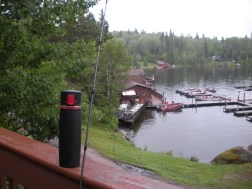 I spent last week at Stanley’s Resort on Eagle Lake near Vermilion Bay, Ontario, some of the most beautiful country I’ve seen and a marvelous staff. I was there with my husband, brother-in-law and his wife learning to fish and I couldn’t help but be struck by how much fishing is like writing.


 We all come with baggage. It starts collecting from the moment we are conceived and doesn’t end until the day we die. It’s what we do with that baggage that builds our character, the ever-changing person we become.
 First love. Young love. Puppy love. True love. Second chance at love. Love makes the world go round. Whatever you call it, we are all in love with love.
