Morning Coffee: Valentines and Roses

Valentine 1Approximately 150 million cards are exchanged annually for Valentine’s Day, second only to Christmas (an estimated 2.6 billion). Despite the claims of men, Valentine’s Day was not an invention of Hallmark to sell more greeting cards. Nor was it the brainchild of some florist or chocolatier looking to increase profits; although, all three have certainly seized at the opportunity.

Valentine’s Day has its roots in a pagan festival. Some believe St Valentine’s Feast was held in mid-February to coincide with the anniversary of the saint’s death or burial thought to have occurred in A.D. 270, while others claim it was the decision of the Church in an attempt to Christianize the pagan celebration of Lupercalia, a fertility festival dedicated to Fauna, the Roman god of agriculture, and to the Roman founders Romulus and Remus. At the end of the 5th century, Pope Gelasius officially declared Lupercalia to be unchristian and named February 14th St. Valentine’s Day. It would not be until much later that the holiday would be definitively thought of as a celebration of love and romance.

Valentine greetings date back as far as the Middle Ages, but it wasn’t until after 1400 that the written greeting appeared. The oldest Valentine still in existence is a poem written in 1415 by Charles, Duke of Orleans, to his wife while he was imprisoned in the Tower of London. It is believed that several years later King Henry V hired writer John Lydgate to compose a valentine for Catherine of Valois. By 1900 pre-printed cards began to replace the traditional hand-written note.

Today our Valentine greeting is about much more than a simple greeting card. One of the most popular Valentine’s gifts is flowers. We all recognize roses as the traditional Valentine’s Day flower, but did you know that the color of the rose is as important as the gesture itself? Red roses mean love, longing or desire. The number of red roses given also holds special meaning. Twelve red roses means “Be mine” and “I love you.” White roses mean purity, chastity and innocence. Yellow roses express exuberance, sunny feelings of joy, warmth and welcome. They symbolize friendship and caring. Pink roses express gentle emotions such as admiration, joy and gratitude, also elegance and grace. Light pink mean sweetness and innocence. Orange roses signify passion and energy, intense desire, pride and fervor, even a sense of fascination. Lavender roses are the color of enchantment, love at first sight. Darker shades closer to purple invoke a sense of regal majesty and splendor, express fascination and adoration. Blue roses do not occur naturally, thus representing the unattainable or mysterious. Green roses are the color of harmony, opulence, fertility. They are the color of peace and tranquility. Black roses, the color of death and farewell, the death of a feeling or idea. A mixed bouquet represents a mix of emotions, depending on the colors chosen. It could mean “I love you and my intentions are honorable”, “I love you even though I know you can never be mine”, or even “I don’t know how I feel but care enough to send you these roses”.

Next week we continue our journey into Valentine’s Day traditions with “Candy Hearts and Chocolate”.

Morning Coffee: Valentine’s Day

Valentine 2St. Valentine and Cupid, the two figures, one real and one myth, most closely associated with Valentine ’s Day. Who was St. Valentine? The answer to that question is unclear.

The Catholic Church recognizes three different saints named Valentine or Valentinus, all martyred. One was a priest who served in the third century Roman army. Emperor Claudius II believed single men made better soldiers, men not distracted by a wife and family, so he made it illegal for young men to marry. Legend has it this soldier priest defied the decree by secretly marrying young soldiers who had fallen in love. When the emperor learned of this, he ordered Valentine put to death. Other legends suggest Valentine, while imprisoned and awaiting his execution, may have been killed helping Christians escape from the tortures of Roman prisons. According to one legend he actually composed and sent the first “Valentine” after falling in love with a young girl, perhaps his jailor’s daughter, who visited him regularly. He is supposed to have signed his greeting “From your Valentine”. The one thing the legends all have in common is the portrayal of Valentine as a sympathetic, romantic hero. By the Middle Ages, Valentine would become one of the most popular saints in England and France.

Perhaps the most familiar symbol of Valentine’s Day is Cupid, that fat winged little angel with the arrows that are supposed to make their target fall in love. This vision of Cupid, son of Venus, Goddess of Love, comes from Roman mythology. However, Greek mythology envisioned Cupid much differently.

Eros, the son of Aphrodite, Greek Goddess of Love, was a handsome young man who made the mistake of falling in love with a mortal woman, Psyche, said to be even more beautiful than his jealous mother. Aphrodite sent a plague to Earth and made it known the only way to end the suffering was to sacrifice Psyche. The King, Psyche’s father, bound her and left her to be devoured by a fearsome monster. Eros rescued Psyche and married her. His one requirement, though, was that his bride never see his face. This did not bother Psyche as she was happy with her husband who was a wonderful lover by night and left her to live in unimaginable luxury by day. Unfortunately, Psyche had two sisters who were just as jealous of their sister’s beauty as was Aphrodite. They convinced Psyche her husband must in truth be a horrible monster. So one night Psyche lit a candle to see for herself. Instead of something ugly and fearsome, she saw the face of a god. As Psyche gazed at the sleeping Eros, her candle dripped hot wax and he awoke. Angry at her betrayal, Eros flew away. Devastated, Psyche begged her mother-in-law for another chance. Aphrodite set Psyche on a quest to complete four tasks in order to win back Eros’ love. Psyche managed to accomplish the first three tasks with the help of ants, a reed, and an eagle, but the fourth task became her downfall. Aphrodite sent Psyche to the underworld to steal a box of Persephone’s beauty cream. Again with help, Psyche learned how to find the entryway to the underworld, how to get around the guards Charon and Cerberus, and how to behave in the presence of the Queen of the Underworld. But, as Aphrodite predicted would happen, Psyche could not resist the temptation to open the box. Psyche reasoned that if the most perfect goddess Aphrodite could be made even more beautiful by this cream, imagine what it would do for her, an imperfect mortal. Upon opening the box, Psyche fell into a deathlike sleep. With the help of Zeus, Eros brought his sleeping wife to Olympus, where she was given nectar and ambrosia and thus made immortal. On Olympus, in the presence of the other gods, Aphrodite was forced to accept Psyche as her daughter-in-law. Psyche would soon give birth to a daughter named Pleasure.

In Latin the word Cupid means “desire”, that emotion we celebrate this Sunday by giving our loved ones cards, flowers, candy…perhaps that much-anticipated ring. Come back next week and read about the origins of those traditional Valentine’s Day gifts.

Morning Coffee:For the Love of Romance

Valentine 1Even though Valentine’s Day is not until the 14th, and the 14th only according to my calendar, February has long been celebrated as the unofficial month of romance. I petition that we make it official, get it acknowledged on calendars everywhere. February: The Month of Love and Romance. I love romance! That’s why I’ve chosen to write romances, like to read romances, and am a sucker for a good Hallmark or Lifetime movie romance. There is so much fear and hate in this world, so much unhappy dragging of our feet from one day into the next, that I think it’s good to be reminded that love still exists and love will win out if we let it, even if only in our heart.

I’ll be attending an event on Saturday the 13th called “For the Love of Romance” and you’re all invited. It will be from 10am to 1pm at Deb’s Café (formerly Camille’s) at 1120 122nd St in Chippewa Falls (off Melby Rd). This is where romance readers can meet romance writers. Authors scheduled to be there include Ashylnn Monroe, Tina Susedik, Michel Prince, Ginger Ring, Beth James, Cheryl Yeko, Randi Alexander, Steve Mitchell, Patti Fiala, C.J. Bower, Wendy Stenzel Oleson, Marc Stevens, Anita Kidesu, and Alaska Angelini. There will be a meet & greet at 10:00, a Q&A panel at 11:00, and a book signing at 12:00 (books will be available for purchase or you can bring your copy from home). Come early as the first 20 attendees will receive a special gift bag!

For the Love of Romance Poster

Come join us for the fun! I hear it was a big success last year and regret I didn’t know about it until after the fact. As for next year, my goal is to be sitting with the authors and signing copies of “Mary Bishop” for all of you.

Until then, join me each week as I bring you my own month of romance, covering such topics as St Valentine, Cupid, medieval courtly love, and the history of chocolate.

Morning Coffee: Life Happens

Dickens“Life happens”, or so they say. It’s true. Sometimes life gets in the way of us doing what we want to do. We want to be writing but we have to go to work, one of the kids is sick, the dog needs to go to the vet, or it snows two feet and after hours of shoveling you can hardly move let alone think. That was no doubt the problem for many writers across the east coast this past week.

In most cases we just have to resign ourselves to the interruption and do what we must knowing there will be time to write later. But, rather than give up entirely, use this time to observe. We are surrounded every day with sights and sounds that could build a life-time of stories. You never know, you might find the answer to your plot problem, or your character question, in an overheard conversation on the bus or at the next table in the café. Don’t let anyone suggest you’re wasting time by reading a book when you could be writing yours. Tell them you’re studying the methods of another writer in order to strengthen your own.

As for that snow storm, that is a blessing in disguise. Yes, if you can’t get to work that means the kids can’t get to school. Bundle up with them and go outside and play! When was the last time you built a snowman, or an igloo? When was the last time you packed a snowball in your hands and surprised someone with a thunk in the back? Be a kid again. Go sledding or ice skating. I bet you’ve forgotten what it’s like to feel that icy wind in your face as you fly down a fresh snow-covered hillside. Later you can go for a walk with your love or your best friend, or even alone. Walking down the street under the muted glow of the street lamps, the whole world silent but for the crunch of your boots as they pack the snow beneath your feet, large fluffy snowflakes falling slowly all around, brings an amazing sense of peace.

And at the end of the day, a bubble bath with a scented candle, quiet music, lights low, and a glass of wine. Congratulate yourself for a day of work well-done…it’s called “research”.

Sledding by Jane Yunker

Boots kick silently through fresh snow,

long tracks in late afternoon shadows.

Alone I stand, white slope,

virgin snow, untouched.

Running belly flop, head down,

wind chapping cheeks, stinging eyes,

heart pounding with the thrill,

gliding to a slow stop.

Boots kick silently back through fresh snow,

humming, smiling, I trek down

streets deserted, lights twinkling,

windows steaming, dinner waiting.

Morning Coffee: Girlfriends/Sisters

“Friends are the family we choose for ourselves.” Edna Buchanan, journalist and author.

VegasAs women we define ourselves by our relationships with others. It’s not only about our external roles…daughter, sister, mother, friend…but how we validate our internal emotions. Only another woman can understand the pain of miscarriage. Only another woman can understand the loss felt when you suddenly go from being the primary caregiver of young children to an empty-nester to having to care for an aging parent, a parent who might not even remember who you are.

A girlfriend will try to catch you when you try on those gorgeous 4-inch heels and then laugh with you when you both end up sprawled on the shoe store floor while everyone else stares as if you’re drunk, or perhaps insane. A girlfriend always has a tissue handy when you’re crying or a bottle of wine chilled and ready when you’re angry after a bad day at the office. It doesn’t matter if your one great love broke your heart, your pet died, or you’re watching that same sad movie for the umpteenth time, your girlfriend always has an understanding ear and a ready shoulder.

There are friendships that inspire us, such as Marilyn Monroe and Ella Fitzgerald. The famous sex symbol so idolized her friend, the Queen of Jazz, that in a time when black musicians couldn’t get hired anywhere but a black nightclub Marilyn promised a white nightclub owner she would sit in the front row every night for a week if he would hire Ella to perform in his club. Then there are the television friendships that spilled into real life. Lucille Ball and Vivian Vance were fast friends both on screen and off. Who doesn’t still laugh out loud when watching the chocolate factory scene? You can’t fake that kind of chemistry,not for all the awards in Hollywood. Although Vivian (“Ethel”) wasn’t on screen for vitameatavegamin you know she had to be standing right behind the camera stifling a laugh as she watched her friend stammer and stumble through that commercial pitch time and time again, each more ridiculous than the last.

Without our girlfriends we feel isolated, alone. Just try telling your husband about your bad day. Instead of listening, nodding, pouring you a glass of wine, he’ll tell you why his day was worse and then proceed to tell you how to “fix” your problem. A girlfriend doesn’t do that. In my novel, “Mary Bishop”, Mary mourns the loss of all the close women in her life: her mother, sisters, friends. Some have died while others disappeared after the Civil War ended. Only another woman who’d lived it could understand what they went through during that divisive and uncertain time; only another woman knew what it was like to have a son or husband, a love or a brother or father, march off one day never to return. Mary’s pain has formed a wall around her heart that she struggles to break through as she looks to form new friendships in a new town where anger and bitterness seem to be the predominant moods.

I’m one of the lucky ones. My best friend is my sister. We just returned from six days in Las Vegas. It’s an annual trip we both look forward to. There was a lot of laughter and a little gossiping. We talked about our children, our jobs, school (she recently went back for her degree). We drank, we gambled, and, yes, we tried on shoes. Let’s just say she rocks those 4-inch heels. Me, not so much. I’m more likely to be the one on the shoe store floor.

Tell me about your best girlfriend or sister.

Morning Coffee: Curiosity

winterCuriosity might kill the cat, but it feeds the writer. What was it like to be a woman on the prairie, trapped and alone in her cabin during a howling week-long blizzard, not knowing if her husband is riding it out in town or trapped somewhere between there and home? What was it like to have to marry a man twice your age, someone you barely knew, a widower with a half dozen children from his first wife, because your father arranged it? What was it like to have to leave behind all your friends and family, the only way of life you’ve ever known, because your husband wants to go west and start over? What was it like to be a woman during a time when women had little say in such decisions?

The answers to some questions can prove to be too frightening. What will happen if I fill this blank paper with words and send it to a publisher? Maybe they’ll love it and print it and the whole world will come to idolize me. Maybe I’ll just make a complete fool of myself.

Other questions, like the ones above that fill my head, are a tantalizing invitation to visit a long ago time and place and the people who lived there. They’re a chance to open doors to entire worlds other than my own.

fawn 2014I took this picture of a fawn cautiously checking out the fenced-in portion of our yard a couple years ago. We normally close that gate (to keep the deer out) but my husband had accidently left it open and this little one was drawn to the unknown so enticingly beckoning from the other side. She stood at the open gate and stretched her neck to look inside but she would not step past the threshold. Mom stayed a little ways back, closer to the trees, keeping an eye on her young one but not too terribly concerned. “What’s in there?” the fawn wondered. “I want to know but I’m afraid it could be dangerous so I won’t go in. I’ll just stand here and look.” Then she saw me standing just inside the sunroom with my camera. I froze. She froze. Then she turned and ran, mom close behind.

Do you turn and run when faced with the unknown? Or do you jump in with both feet?

Morning Coffee: Inspiration

ChristmasWriters are readers. Voracious readers! I’ve loved books as long as I can remember, couldn’t wait to learn how to read them on my own. Right now I have more books than I could probably finish reading before I die, but I continue to buy more. They’re just so tempting! Those beautiful covers, blurbs that promise romance, adventure, suspense, horror…doesn’t matter to me. I often read more than one book at a time. I’ll usually have at least one nonfiction book going, one fiction, one collection of short fiction (not to mention all the dog-eared magazines). Which one I pick up at any given time depends on my mood and just how caught up I am in the story.
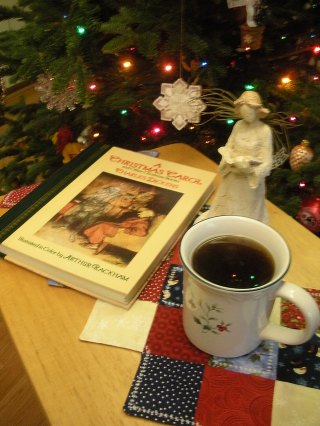
Right now I’m part way through nonfiction “The Collected Letters of Willa Cather” and “Little Demon In The City of Light: A True Story of Murder in Belle Epoque Paris” by Steven Levingston; collections of short fiction “A Basket Brigade Christmas” and “The 12 Brides of Christmas Collection”; and fiction “Eureka Valley: Grandfathers’ Grandfathers” by Lisa Doerr and “The Calling” by Beth M. James.

Every book I read is an inspiration to me. It might be how the author handles point of view (particularly multiple points of view) or tense. It might be a turn of phrase describing something as everyday as washing your hair. (Beth James has a particularly sensual hair washing scene in “The Calling”.) I find it interesting how another author chooses a title, or a character’s name. I love when a particularly well-written story takes me to another place so completely I forget where I am, get lost in the passage of time, and I study how he/she did that with such apparent ease. (The really good stuff always seems easy and never is.)

Like my novel “Mary Bishop”, “The Calling” is told through parallel timelines. Mine are between pre-war Virginia and 1881 Wisconsin. “The Calling” is between present day Chicago and a fantasy world. Jessie is seriously injured saving children from a burning house. While in a coma she finds herself in a fantasy world where she is taken into the protective care of a handsome warrior after he finds her injured and unconscious with no memory of her other life. When she wakes from her coma she’s convinced this parallel world is real and pines for her warrior love, while her fiancé, Walt, tries to convince her it was all a dream. Which was it? Reality or a dream? I don’t know yet. I’m only half way through. But you can bet I will be finishing the book to find out. I wish I didn’t have to get up each morning and go to my day job. I could get through all these books much quicker.

Are you a writer? What books do you find inspirational?

Morning Coffee: New Year’s Resolutions

ChristmasEvery year I, like many of you, admit it, make a list of resolutions for the coming year that rarely, if ever, succeed. Top of the list is the popular eat healthy / exercise / lose weight. It lasts for a while because by January I’m tired of all the sweets and rich foods that surrounded the previous holiday months, but then it ultimately fails. By the end of the now not-so-new year I’m back where I started, if not a little worse off, thus leading to a renewal of that same old resolution to eat healthy / exercise / lose weight.

This year I’m trying a different approach. Instead of calling them New Year’s Resolutions (almost guaranteeing failure), I’m calling it my Author’s Business Plan. The leader of my local chapter of Wisconsin Romance Writers of America (WisRWA) gave us a 4-page questionnaire to direct our thoughts as we determine our goals and how we plan to achieve them over the coming year. At the end it asks for our exit plan; that is, what is our plan should we not succeed in reaching one or all of our goals.

I already have a favorable start on one of mine, to reach 100+ followers for this blog. I’m up to 92 so it seems a reasonable assumption I can gain at least eight more over the next twelve months. But another goal (I listed six total) is going to be a tough one. I plan to have the revisions on my novel, “Mary Bishop”, completed by the end of February. You see, by that time my part-time day job will go full-time for a couple months while I fill in for a co-worker on maternity leave, making it the best time to have my manuscript out to Beta readers for further comments. Unfortunately, the holidays made writing almost impossible. So, here it is the end of December and I’m not where I wanted to be by now and my day job hours are already increasing as I train for my added responsibilities. Does this mean I throw up my hands and give up? It’s tempting, but I keep reminding myself I still have two months and the revisions for the first two-thirds of my novel are all hand-written so a solid couple of days of typing and tweaking should accomplish that step. The final third needs a much more thorough re-write to expand the current chapters and add some new ones in order to fill-in holes my critique group outlined.

Can I achieve that goal? Not if I decide it’s already hopeless. However, two months (8 weeks, 60 days) is a long enough time if I stick to it. Of course, my co-worker could easily go into labor early, or end up on mandatory bed rest. I will no doubt start my full-time schedule at some point in the last week or two of February, and very possibly with little notice. If that happens and I’m not done with my revisions I will just have to keep plugging along with what free time I do have. (Consider how much time we waste every day worrying about how we don’t have enough time.) And what better incentive than to write it down on paper and then share it with eight other women who are cheering for my success.

My ultimate goal for 2016 is, of course, a signed publishing contract. Or, at the very least, a publisher interested enough to want to read the entire manuscript and discuss a possible contract. Can I get there? Yes! Experts in how to be successful say believing in yourself, being able to visualize your own success, is a necessary part of achieving that success. My exit plan? Keep trying, obviously. Who knows what 2017 will bring? Hopefully a second book contract.

Morning Coffee: Christmas Sonnet

Christmas Sonnet       by Jane Yunker

The shepherds sat among their sheep that night

and heard the angels voices raised in joy.

They saw the star that brightly shone, a light,

a guide to lead them to the baby boy.

Three wise men also saw the gleaming star

and followed endless day and night to bring

their gifts both rare and pure borne from afar,

most precious gifts to give the new-born king.

Found sleeping in a manger, in the hay

surrounded by the beasts His glory shone,

as they went down on bended knee to pray,

to honor Him on His most lowly throne.

Sing praises to the holy infant child

born to a blessed virgin mother mild.

Morning Coffee: Christmas Truce

ChristmasIt’s Christmas Eve 1914, a mud-filled foxhole in northern France. Not the place any young man expected to be spending this holiest of nights. Allied forces on one side, the Germans on the other, many of these young men expected to make quick work of the fighting and be home in time to celebrate Christmas with their families. Yet, here they were knee-deep in mud, drenched by the almost non-stop rain, staring down the barrels of their guns at each other across the blood-soaked Western Front.

A million lives had already been lost and there was no end in sight.

Charles Brewer, a 19-year-old British lieutenant with the Bedfordshire Regiment of the 2nd Battalion was glad to see the rain stop and the skies clear on this now moonlit Christmas Eve. All was quiet when a sentry spied a glistening light on one of the German parapets less than 100 yards away. Aware it might be a trap, Brewer slowly lifted his head to look over the sandbags and through the barbed wire to see that it was a Christmas tree. Along the German trenches was a line of lit trees, glimmering in the night like a string of beads. From behind that line rose the faint sound of singing – a Christmas carol. The words to “Stille Nacht” were not familiar to the British troops, but the melody certainly was. When the Germans finished singing the British responded with a round of cheering and sang the English version of the carol – “Silent Night.”

The dawn of Christmas Day brought something even more remarkable. In pockets all along the 500-mile Western Front, German and Allied forces laid down their arms and walked tentatively through the no-man’s land between their lines. They stepped around the burned trees, shell craters, and the trenches filled with the frozen bodies of their dead. They climbed over the sandbags and avoided the barbed wire to shake hands with the men who had been their enemies only the day before and wish them a Merry Christmas. Political leaders had ignored Pope Benedict XV’s call for a Christmas cease fire but these men did not, initiating their own spontaneous and unofficial armistice.

“We shook hands, wished each other a Merry Xmas and were soon conversing as if we had known each other for years,” British Corporal John Ferguson wrote of that Christmas Day between his Seaforth Highlanders and German forces. “Here we were laughing and chatting to men whom only a few hours before we were trying to kill.”

“Almost always, it was the Germans who at least indirectly invited the truce,” writes Stanley Weintraub in his book “Silent Night: The Story of the World War I Christmas Truce.” Many of the German soldiers had lived and worked in Great Britain before the war and spoke English.

The men exchanged gifts of cigarettes, chocolates, sausages, liquor and plum puddings. They shared stories of the hardships of war. German soldiers in Houplines rolled a barrel of beer they had seized from a near-by brewery across no-man’s land to share with their new Allied friends. It was unanimously agreed that “French beer was rotten stuff.”

There were pick-up soccer games in no-man’s land where players had to navigate around barbed wire and shell craters. They marked goals with their caps. Where there wasn’t a real leather ball to kick, tin cans and small sandbags worked just as well.

Not everyone was moved by the spirit of Christmas. Fighting continued along some areas of the Front. There were soldiers killed who, in the hopes of a Christmas cease fire of their own, attempted to cross the lines in an offer of peace. German leaders were concerned their men might lose the will to fight. One in particular, a young Adolph Hitler, scolded his fellow soldiers. “Such a thing should not happen in wartime! Have you no German sense of honor left?”

As Christmas Day 1914 came to an end the men parted ways. A few cease fires continued until New Year’s but most resumed fighting the next morning. At 8:30am on the 26th, in Houplines, Captain Charles Stockwell of the 2nd Royal Welch Fusiliers fired three shots into the air and raised a flag that read “Merry Christmas.” His German counterpart raised a flag that read “Thank you.” The two men mounted the parapets, saluted each other and returned to their trenches. Stockwell wrote that his counterpart then “fired two shots in the air—and the war was on again.”

British Expeditionary Force commander John French ordered that such a spontaneous grassroots cease fire should never happen again, and it did not. Millions of more lives would be lost before the guns would fall silent once more with the signing of the armistice on November 11, 1918. The 1914 Christmas Truce, though, would not be forgotten. One British soldier wrote home the following day, “I wouldn’t have missed the experience of yesterday for the most gorgeous Christmas dinner in England.”

May Christmas 2015 be one to remember. A very Merry Christmas from my house to yours!