
 Last week I wrote about making your feedback to others matter. This week I’m talking about the opposite, how to take comments on your own work with grace. It’s not as easy as you think. In fact, it’s a lot more difficult to be open-minded when it comes to your own words under fire. I know, because I’m not always the best at it myself.
First, you have to learn how to listen and not talk. Unless you’re asked a question, you just listen. Do not defend. Remember, this is one person’s opinion and you can choose to either go with it, or ignore it later.
Second, take plenty of notes. You don’t want to be in a position later of trying to remember what someone said because now you suspect they might be right and you want to revisit the idea.
Third, smile. At least pretend to be interested. If you scowl, if you look angry or put out, that person might hold back for fear they’re hurting your feelings, or also get angry. You could miss out on something that could improve your work.
And, fourth, don’t discount any of the comments until you’ve given yourself plenty of time to consider them. Go home, set aside your manuscript with notes, and come back to it later when you’ve had a chance to cool off a little. On more than one occasion I’ve realized a comment that seemed ludicrous at the time really did make sense. I was convinced I was saying exactly what they claimed I was not saying, or I certainly wasn’t saying what they said I was saying, so the fault was with them and not me. But then, after a suitable length of time had passed and I reread that part, I realized what I thought I was saying was not what my reader was reading. It didn’t matter what I thought was there, it wasn’t coming across clearly to my reader and when you come down to it that’s what matters. That’s the goal. You know what you want your reader to experience and it’s your job as a writer to make sure that happens.
This works just as well outside creative writing. It could be a report for school or work. It could be your annual job performance review. My advice remains the same: ears open, lips closed and smile firmly in place. The only sounds should be of your critique partner speaking, and your pen or pencil madly scratching out notes…if it’s an appropriate note-taking occasion.
Like I said, they are only the opinions of one person. If, after you have given the matter much thought you still believe your version is better, then your version is better.
 I recently had the opportunity to judge a writing competition. I’ve critiqued before, but always friends, people I know, and I was sitting with them at the time. I was able to look them in the eyes, answer questions if I wasn’t clear, see if I was too rough and needed to maybe tone it down a little. This time I was emailed eleven blind entries. No names, no identifying information. And I didn’t give just comments, but actual number scores. Some would rank higher than others and it would be me who made that decision. I’m not the only judge for these entries. There are several others for each entry and an average is awarded, with the lowest thrown out for good measure. I know that if no one else agrees with me and I’m the lowest score, I’ll be the one set aside.
 Do you journal? I don’t. At least, not in the traditional sense. I’ve tried a few times but I always end up destroying the few pages I actually write because they either sound boring to me, or I’m afraid of who might find and read them after I’m dead. I’m never sure that’s the lasting memory of me I want floating around out there.
 Spring is a very fickle time of year. One morning you wake to a sunny day with temperatures rising into the low 60s, and then the next the clouds roll in bringing harsh winds and snow. In between you’re likely to have a strong front barrel through with severe storms and the threat of a possible tornado. March, the month that holds out its hand in promise, only to yank it away again, is the worst of all the fickle ladies of spring. We’ve seen it all and we’re only a week and a half in.
 Winter isn’t done, but spring is definitely just around the corner. For the last week we’ve had mild temps in the 50s, even the low 60s. The snow is gone, except for the banks left by the plows. The smell of wet earth promises flowers soon. The first round of maple sapping was under way this past weekend. There have even been bear sightings.
 This week was Valentine’s Day. That one day a year that brings to mind roses, chocolates, wine and a special dinner out. The day when the one who loves you most is supposed to do something extra to let you know, and vice versa.
 We live in a fast-paced world where everything is tightly scheduled and there is no room for deviation. Children no longer go outside to play after school or on the weekend. They are too busy being chauffeured to their various sports activities, music lessons, and the tutoring that will hopefully get them into a better university after graduation. Even pre-schoolers have scheduled “play dates”. No one sits on their front porch anymore, waving to their neighbors as they walk by, inviting them to stop and chat over a cold drink. Most don’t even know their neighbors’ names. Children no longer play kick-the-can in the growing darkness until their mothers holler out the back door that it’s time to come in. Dad’s in one room reviewing departmental reports while mom is in another preparing for her big morning presentation in front of the Board. Meanwhile, if by chance the children are actually done with their homework, they are on their computers either perusing their social media accounts or deep into a multi-player video game, stopping only long enough to answer a text from their friend who probably lives right next door or across the street. None of them, parents included, can even sit down for a family meal together without their cell phones right there within easy reach. Ask them an hour later what they had for dinner and I’d wager a bet most of them couldn’t tell you. Did they even taste it? We live in a world of texts written in indecipherable shorthand, tweets of 140 characters or less, and emojis.
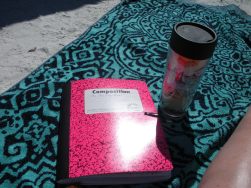 Two weeks ago I wrote about my plans to “shake things up”. Well, this was the week and I’m calling it a complete success! I’ve spent the last three days on Ft Myers Beach, just me and my notebook on the beautiful Gulf shore with hundreds of my closest friends. . .but that added to my success. I sat in the warm sand and listened to the surf and the gulls; watched small children play in the water (LOL), retired couples walk hand-in-hand (smile), and parasailers soar overhead (bucket list!); and I wrote. I wrote and I wrote. Drafting in long-hand, as hoped, opened up my creativity. I wasn’t tempted to go back and edit, the way I am when I’m on the computer. I wasn’t confined to writing where there was an electrical outlet and no damaging sand and water. And note paper doesn’t have that sun glare problem! I could go anywhere. I wrote on the beach and poolside. I wrote in my room. I wrote sitting at an outside table of a little Greek restaurant while enjoying one of their delicious gyros. My notebook and pen went in my beach tote every morning and followed wherever my wondering feet led me. When I was inspired, when a plot question resolved itself in my mind, all I had to do was find a place to sit and write.
 Each of those three days I wrote one chapter. Today I will write a fourth and tomorrow a fifth. I estimate a total of 40-50 pages completed by the end of my trip. To some writers that might be a set-back, but for me it was very productive. After all, I needed to leave time to walk, shop, and read; time to allow the tropical sunshine to recharge my half-frozen northern brain.
 Jane Yunker, Author