 Hubris, the Greek word for Man acting like a God, excessive pride or self-confidence. The ancient Greeks believed the gods punished those who did not recognize and live within their own limits.
They tell the cautionary tale of Daedalus. He fashioned wings using feathers and wax and with these wings he was able to fly. He gave a pair to his son, Icarus, but with the warning not to fly too close to the water or they would get wet, nor fly too close to the sun or they would melt. The shepherds and plowmen who witnessed their flight from below believed them to be gods. Well, we all know how this story ends. Icarus, filled with the arrogance that comes with pride does, indeed, fly too close to the sun. The wax melts from his wings, he falls to the ocean below, and he drowns. Hubris caused Daedalus to lose his son, and Icarus to lose his life.
Such tales of pride, though usually not as colorful or dramatic, are not absent from today’s world. For example, just because we are capable of manufacturing nuclear weapons does not mean we should. God gave some of us great knowledge with which we can create great things, but with that there is also great power. . .and power can be abused. Armies with massive weaponry can either protect us or tempt our leaders to go where we don’t belong, or take what is not ours. Ventilators that can buy an ailing and damaged body the time to heal can also keep someone otherwise deceased “alive” for untold days, weeks, months, even years, without any hope of recovery. Where is the line between true greatness and hubris? How can we defeat the Siren’s song that lies deep within us all?
I don’t know if I have the answer to those questions. The line is gray, blurred, often shifting position depending on circumstances. All we can do is look deep within our heart, pray for guidance, and ask ourselves what our true motive is, whether it is money or fame or the hope for a solution to a much bigger problem. We can vote for leaders who are wise and willing to listen to their advisors, able to weigh all the possible outcomes to their actions and pick the best for all. . .even when every option on the table is undesirable in and of itself. As individuals, we should remember our words can hurt or they can heal, but they cannot be unsaid once out of our mouths. We should be more aware of our actions toward our family, friends, neighbors, even strangers. When you see someone in need and you look away, ask yourself why.
Humility is the opposite of hubris. It doesn’t mean living beneath our God-given talents, ignoring the knowledge we were born to achieve. But it does mean recognizing what is good and what is not, what will bring good to others and what will only bring good to us. Our naturally sinful nature means we will not, cannot, always succeed, but shouldn’t we at least try?
Fall From Grace
By Jane Yunker
Adam fell from God’s eye.
Not soft and gentle as
the seed of the milkweed
drifting on a warm breeze,
but a hard fast freefall,
like Icarus from the sun.
Hot arrogance melting
wax from his wings, releasing
feathers of selfishness
to flutter slowly after,
covering his body in sin.
 Last week I wrote about the power a good book has to transport you to another time, another place. The author has to find just the right words to pull you into their world, make you care so deeply for the characters that it is near impossible to put the book down. That’s my goal.
 There’s power in a good book, a story that pulls you in so deep you feel like you’re there. You can smell, feel, even taste the rain on your face. You can see the rocky cliffs rising behind you and the racing white river in front of you. You feel his arms reach around as he pulls you beneath the protection of overhanging trees, the kiss on your neck, and you’re both happy for and jealous of the heroine. I’m currently totally immersed in the Outlander series–up to book 3.
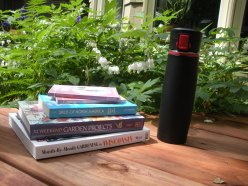 Years ago my mother gave me a blank book entitled “Some Incredibly Important Trivia”. I use it to record sayings that move me, whether funny or thought provoking, it doesn’t matter. My most recent entry is by Eleanor Roosevelt:
 It’s one of those words we use to qualify everything, diminish the meaning of whatever we’re talking about. “I was just saying.” “It was just a little dent.” “I’m just a housewife” or “a secretary” or “a romance writer.” We say it all the time without thinking about it. It rarely serves any true purpose other than to make less of something, often ourselves. We make ourselves a little smaller every time we say, or think, it.
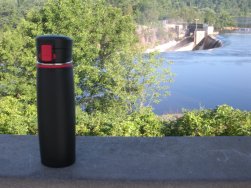
 I have the great fortune of living along the Wisconsin shore of the powerful and beautiful St. Croix River. Approximately 169 miles of waterway runs through the states of Wisconsin and Minnesota, the lower 125 miles forming the border between the two states, until it reaches its mouth at the Mississippi River.
 with cameras to view the impressive cliffs and colorful fall leaves while eagles soar over their heads. Recent heavy storms to the north dumped as much as ten inches of rain, sending a torrent of muddy floodwaters downriver. Roads were washed away; some bridges had to be closed. Scores of people flock daily to the overlooks to experience the power of the river. Sluices on both sides of the dam are full open to help control the tremendous amount of water that is currently rushing over the top of the dam.
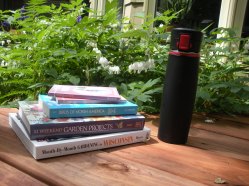 I’m sitting at my desk, sliding door to the deck open. It’s a beautiful summer afternoon. The sun goes in and out from under gray clouds that tease us with the possibility of rain later this evening while throwing long shadows across the yard as the afternoon wears on. I don’t have to work today and I’ve done enough housework to quell any feelings of guilt so now I’m enjoying the down time while revising the final chapters of “Mary Bishop”.
 Jane Yunker, Author