Morning Coffee: Hallmark Addiction

Healing HeartI have a new addiction: Hallmark romance movies. Saturdays from ten in the morning to ten at night I can watch six Hallmark original movies about love and romance. In fact, that’s what I’m doing as I write this blog. Every now and then there’s an actress/actor/storyline that doesn’t interest me, or life interrupts and I have to record for later, but it no longer feels like Saturday without at least a couple Hallmark movies under my belt. Then I round out my weekend with their new Sunday night series, Chesapeake Shores. They make me laugh. They make me cry. They make me smile.

Week days are filled with a million responsibilities, chores, expectations. Our schedules both at work and at home keep us all hopping. Then there are the committees, the foundations, all the volunteer opportunities that allow us to give back to our communities and our churches. At the end of the day we are left with very little time for ourselves, sometimes even for those we love the most.

Everyone needs to make time in their life for a little love and romance…or a lot of love and romance. Not just romance movies and books, although I whole-heartedly recommend them, but through the little things we do for or with the one we love.

Turn off the television and turn on some nice music during dinner. Light a candle, pour some wine, and actually talk to each other, maybe get up and dance. Later, finish off that bottle of wine as you share a bubble bath. In between, wash those dinner dishes together. That’s right, you heard me, even washing the dishes can be romantic if done together. Your hands touch over the dish drainer; you brush against each other in passing.

Romance isn’t all grand gestures, expensive jewelry, or exotic vacations. It’s found in those small moments. It’s there when you laugh together about your day. It’s in the shoulder or foot rubs, the quick hug as you pass in the hall. It’s there when you kiss good night and again when you open your eyes in the morning and that person lying next to you smiles.

Romance isn’t only for the rich, young, and good-looking. Romance is free and it’s for everyone.

Morning Coffee: Plotter or Pantser II

Healing HeartWhen I wrote my first novel, Mary Bishop, I was very much a “pantser”. I sat down one day and just started writing, the story coming to me “by the seat of my pants”, so to speak. This worked for me because my heroine was telling me her story and insisting I get it down as fast as I could. Unfortunately, by the time I reached the end of my first draft this had become a problem. You see, while I wrote, questions came to mind; and as I answered those questions, I had to keep going back and making changes. Then when my critique group read my first draft they called me out for being lazy, leaving out long sections of time because it was easier than trying to answer some of the tougher questions about my heroine’s back story. They were right. This meant I had to go back and revise my existing chapters as well as add many new ones. I even added an entirely new character that had to now be accounted for throughout the book. By the time I was done, my manuscript had almost doubled in length and was, I admit, much improved. But it was accomplished over a longer period of time than necessary.

So, as I prepare to begin writing my second novel, The Healing Heart, I’m trying a new approach. I’m going to become a “plotter”. Some plotters map out their manuscript down to the last detail and then stick to that outline until the last word. Not me, I can’t go quite that far. I recognize my characters are going to insist on going their own way from time to time and I will want to follow them. But at the same time, if at all possible, I don’t want to find myself back in the position of having to do some of those same major rewrites I experienced the first time around.

I started with my characters. My friend Danielle shared with me her “character profile” form, two pages of questions meant to fully define each character’s past and present. This tool has proven to be invaluable. In order to answer each question I have to consider everything about them that makes them who they are, and it’s raised additional questions that are adding to my plot. I won’t use every little detail of their back stories, but they are more real to me now and will act according to the life experiences they’ve had in their past.

I’m currently researching my plotting questions. The Healing Heart takes place against a backdrop of WWI, the Spanish Flu epidemic, and early nursing. As a history major, I love research. With all this information at hand I’ll be able to craft a general outline of my plot and then, only then, will I be ready to start writing. Hopefully, even though all this pre-planning delays the start of my writing, it will make that part of the process go much smoother with fewer major revisions.

So, as the days grow shorter and the nights longer and colder, as the trees begin to show a hint of the bright colors to come, and I try to patiently await word from publishers regarding my first novel, join me as I happily delve into the world of my second novel.

Morning Coffee: The Power of a Good Book II

feetLast week I wrote about the power a good book has to transport you to another time, another place. The author has to find just the right words to pull you into their world, make you care so deeply for the characters that it is near impossible to put the book down. That’s my goal.

In my novel, “Mary Bishop”, Earl and Mary move north from Virginia after the Civil War hoping to replace all their pain and loss with a new life in Wisconsin. Instead, when the people of Deer Creek learn the Bishop’s son died fighting for the Confederacy a campaign of harassment begins that leads to Earl’s suicide, leaving Mary alone to fight the on-going hatred while learning to open her heart to the possibility of a new love.

The book opens with Earl’s funeral:

If anyone in town looked up from their business that November morning they would have seen the distant black silhouette of a wagon moving slowly along the hill’s crest. They would have shaken their heads and said, with a slight smile, there goes Mary Bishop, off to bury her husband. Then they would have turned back to their day without a second thought. This I, Mary Bishop, know.

The undertaker drives the team while Reverend Elias Clark sits quietly next to him. I sit straight-backed on a bench next to Earl’s casket, my hands folded over the Bible on my lap. An icy wind cuts across the hilltops and through the pines standing dark against the sky, releasing the last of the leaves to fall and crunch beneath our wheels. It bites at my cheeks, makes my eyes water, loosens the hair I pinned so carefully beneath my hat.

I do not look away. I do not try to shelter myself from the coming storm. Instead, I welcome the numbness that spreads slowly but steadily to my core, as I imagine it must have spread through Earl as he swung limp from that rope he’d thrown over the barn rafter.

Leaving me alone to cut him down. Leaving me alone to drag his lifeless body into the house. Leaving me alone to wash and dress him for burial. Leaving me alone to ride into town and inform the Reverend of his sin. Leaving me alone.

In the second chapter I take the reader back to when Mary first meets Earl. She’s a young girl of twelve and he’s the new boy in town, just fourteen:

I stretched out as still as a stick in the tall grass, flat on my stomach, and pressed my chin as close to the ground as I could. My cap slipped off my head to hang from one braid but I didn’t mind. I wanted to see the world from the viewpoint of the ants, the spiders, the beetles. I watched as they scaled clumps of dirt barely big enough for me to feel beneath my bare feet as if those clumps were great mountains. I held my breath when a bumble bee flew past my head, lightly brushing my ear, stopping to inspect one clover flower after another in search of something sweet….

Footsteps approached, legs swishing through the grass. It was probably one of my brothers, either Harlan or George, sent to find me and I wasn’t ready to go home yet. He stopped in front of me. All I could see were bare feet and legs wet and muddy half way up the calf to the cuff of his rolled up trousers. I smelled fish.

 “What do we have here?” he asked. “Some kind of snake or over-sized beetle bug?”

It wasn’t George or Harlan. It was someone I’d never seen before. From where I lay the sun formed a halo around his unruly curls, the color of roasted chestnuts at Christmas. A string of dripping wet fish hung from one hand; the other held his pole balanced over his shoulder. I had to squint to make out his face through the glare, but he was undoubtedly the cutest boy I’d ever seen.

“Better close your mouth if you don’t want bugs to crawl in.” He plopped down beside me, laying his catch and pole on the ground next to him.

It’s up to you, Reader, to decide if I’ve succeeded.

Morning Coffee: The Power of a Good Book

feetThere’s power in a good book, a story that pulls you in so deep you feel like you’re there. You can smell, feel, even taste the rain on your face. You can see the rocky cliffs rising behind you and the racing white river in front of you. You feel his arms reach around as he pulls you beneath the protection of overhanging trees, the kiss on your neck, and you’re both happy for and jealous of the heroine. I’m currently totally immersed in the Outlander series–up to book 3.
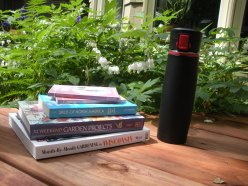
One of my favorites, though, is “Giants In The Earth” by O.E. Rölvaag. It’s a story of Norwegian pioneers in South Dakota in the 1870s. Rölvaag published his story in two volumes, 1924 and 1925, in Norway and then assisted in its translation for American publication in 1927. A fisherman in the Lofoten Islands, Rölvaag came to America and tried his hand at farming in South Dakota in 1896. Finding himself better suited to academics, he attended St Olaf College in Minnesota, and then continued his studies at the University of Oslo. He later returned to St Olaf College where he eventually became a professor of Norwegian literature.

Rölvaag’s writing is simple but powerful. Consider the first two paragraphs of the novel:

“Bright, clear sky over a plain so wide that the rim of the heavens cut down on it around the entire horizon…. Bright, clear sky, to-day, to-morrow, and for all time to come.

… And sun! And still more sun! It set the heavens afire every morning; it grew with the day to quivering golden light—then softened into all the shades of red and purple as evening fell…. Pure color everywhere. A gust of wind, sweeping across the plain, threw into life waves of yellow and blue and green. Now and then a dead black wave would race over the scene…a cloud’s sliding shadow…now and then…”

You’re there, the great flat plains spread out as far as the eye can see, the horizon melting into the sky. He continues:

“It was late afternoon. A small caravan was pushing its way through the tall grass. The track that it left behind was like the wake of a boat—except that instead of widening out astern it closed in again.”

You can feel the hope and promise of a better tomorrow in the sun, and the forewarning of hardship and tragedy in the “dead black wave” that would occasionally “race over the scene”. This is the kind of writing, the kind of bare emotion all writers strive for in their work. It’s the kind of writing that stands the passing of time. It’s been almost 100 years since Rölvaag first published these words and still they move people.

Morning Coffee: Beauty

feetIt is said that beauty is in the eye of the beholder. What’s beautiful to you? Is it flowers blooming in spring? Perhaps an overflowing vegetable garden ready for harvest? A baby’s first smile, full belly laugh, or “mama”?

I love beautiful things. This is obvious if you were to look at my bucket list. Before I die I want to learn how to play the guitar, to draw and paint, and obviously to publish poetry and stories/novels that move people and outlive me. I like to embroider, make jewelry, and put together jigsaw puzzles…the more colorful the better. I like to sing along to the radio; although it may not always be considered a beautiful thing to listen to it makes me happy. I also like to dance, but mostly when no one is looking. I’d love to learn to salsa. I got a taste of that when a friend married a Cuban man and his family took to the reception dance floor. So much joy, you couldn’t help but move your feet. Even my husband, who doesn’t like to dance, joined in.

But most of all I find beauty in a well-turned phrase, the perfect word. It’s why I read so much. And it’s why I write. According to the Global Language Monitor, there is estimated to be 1,035,877.3 words in the English language as of January 1, 2016. A new word is created every 98 minutes, or about 14.7 a day. Amazing!

You can see it in the many ways there are to express love. My Roget’s Thesaurus has twenty-three subheadings under love (noun): affection, self-love, Cupid or Amor (God of Love), courtship, beloved, love affair, ladylove, flirt, love potion, love (verb), cherish, make love, flirt, enamor, in love, loving, lovesick, affectionate, endearing, loved, lovable, amatorial, and flirtatious. And there are numerous suggestions under each subheading. In the Emotion Thesaurus there are pages dedicated to ways to describe love, the way we act when we are in love. It’s the same when you look up any emotion, be it sadness, anger, loneliness, or happiness.

So why is it we rely so heavily on the same vulgar four-letter words when expressing a strong emotion? I know I’m as guilty as anyone else. I’ve been working hard at removing a certain expletive from my golf game but so far with limited success. Perhaps I should use one of my thesauruses to find alternatives and start throwing them into the mix. Even if all it gets me is giggles from my fellow golfers it’s better than the shocked stares I sometimes get now.

The English language is so vast, so varied, that there’s really no excuse not to be exact in our meaning. A good novel should read like poetry; it should transport us to that very place where we can see, hear, smell, feel, even taste what we’re reading. That’s my goal, to create scenes that grab my reader, makes him or her go back and read it again, maybe have to stop and absorb the words before reading further.

Tell me, what do you find beautiful?

002

Morning Coffee: What’s In Your Heart?

SummerYears ago my mother gave me a blank book entitled “Some Incredibly Important Trivia”. I use it to record sayings that move me, whether funny or thought provoking, it doesn’t matter. My most recent entry is by Eleanor Roosevelt:
“Do what you feel in your heart to be right, for you’ll be criticized anyway.”

I’m often asked if what I’m writing is true. Did that happen to me? To someone I know? You can see the sparkle in their eyes as they anticipate some juicy gossip, or the fear that I might be writing about them. Yes, I’m inspired by life around me, maybe something I overheard or saw in passing made me think beyond the actual event and off into the land of what ifs, but I’m not writing anything specific. My life is not that exciting and I’m not so callous as to out a friend in such a public manner. I’ll leave that kind of reporting to The National Enquirer. So relax and set aside that race to judgment.

I can’t be concerned with what others might be thinking about my writing. I can’t question whether or not they will approve of how I choose to tell my story. If I were to put that kind of scrutiny on myself I’d never get anything written.

Nor can I be concerned about what people might be thinking about me based on my characters, or the genre I choose to write. There are people who actually think romance novels are trashy, a waste of time and money. I’ve been told I should write something literary, something great, something that will last for the ages. . .not something that “smacks of money”. That’s right, someone actually accused me once of writing for money, said by doing so I was selling out! (This was in reference to my poetry.) My obvious reply to this person was yes, I write for money. Of course I hope it will be great and stand the test of time; but yes, I also write with the goal of getting paid.

If your writing is a means to a higher purpose and getting paid holds no importance to you, then that’s what you should do. I can only do what feels right to me, be true to my own heart. It’s why I was disappointed when my first submission of “Mary Bishop” was quickly rejected as not suited to their current needs. It’s also why I turned around and sent it right back out to someone else. I will do this over and over until I find that perfect fit, that publisher who is as excited about my book as I am. As for those who choose to criticize me, I choose to ignore them.

Morning Coffee: “Just”

SCF damIt’s one of those words we use to qualify everything, diminish the meaning of whatever we’re talking about. “I was just saying.” “It was just a little dent.” “I’m just a housewife” or “a secretary” or “a romance writer.” We say it all the time without thinking about it. It rarely serves any true purpose other than to make less of something, often ourselves. We make ourselves a little smaller every time we say, or think, it.

Just is one of those words I do a search for when I finish a manuscript. Then I proceed to delete almost every single one. Yes, it has an occasional use, like in dialogue. If my character would have a good reason to say it, then I leave it in; but if not…gone. My writing is automatically stronger without it.

The same with our own dialogue, both internal and external, we’re stronger without it. “It’s just one cookie.” Really? Is it ever just one cookie? If you’re going to eat a cookie, enjoy the cookie. If you have to qualify your actions then maybe you don’t really want to eat that cookie.

“It’s just a little poem (or story) I was playing around with. It’s nothing.” If it’s nothing why did you bother? The fact that you felt the need to write it down means it’s something, right? You’re not just a writer; you’re a Writer. You’re not just a mom; you’re a Mom, arguably one of the hardest and most important jobs out there. Whatever you are, own it, whatever you want to do, do it; don’t qualify it with a word like just.

Once I was asked if I was “still doing my little writing thing.” While technically the word just was not in there the tone of voice used made it very clear what was meant. My answer? “Yes, I’m still writing. And I take it seriously, so please don’t call it my ‘little writing thing’.”

I’m a Writer. I’m a Poet. I’m a Blogger. I realize not everyone is going to appreciate everything I say, some won’t appreciate anything I say, but it doesn’t change who I am. And it’s not going to stop me from saying it.

But let me warn you, there is power in words, my words, your words. Be careful what you’re throwing out there because once a word is out, it stays out. There’s no taking it back. You can change your mind and apologize. The other person can even say they forgive you. But it’s unlikely they’ll forget.

You remember the old children’s rhyme, “Sticks and stones may break my bones but names can never hurt me.” Not true. There’s no such thing as “just words”.

Morning Coffee: River Spirit

SCF damI have the great fortune of living along the Wisconsin shore of the powerful and beautiful St. Croix River. Approximately 169 miles of waterway runs through the states of Wisconsin and Minnesota, the lower 125 miles forming the border between the two states, until it reaches its mouth at the Mississippi River.

The geologic forces that formed the river go back to when the Mid-Continent Rift tore North America in two, forming a volcanic zone. Lava from these volcanoes cooled into hard basalt. A shallow sea grew over the area leaving layers of sand and minerals. Melting glaciers then scraped the land, carving the river’s course, creating the awe-inspiring basalt cliffs of the Interstate Parks and sandstone river bluffs we see today.

Historically, the river has provided a way of life for the Native Americans, French fur trappers, and loggers. Minneapolis General Electric Company began construction on a hydroelectric dam located here in St. Croix Falls in 1903, completing the project three years later. Today it continues to provide power to the Minneapolis/St. Paul metro.

Recreation is now the draw. People come from around the world to boat, fish, camp, and canoe along our river. Numerous trails snake through the woods and along the cliff tops for those who prefer to experience the beauty on foot or two wheels. The steamboats that once transported people and commerce by necessity, now ferry tourists (and locals) armed 007with cameras to view the impressive cliffs and colorful fall leaves while eagles soar over their heads. Recent heavy storms to the north dumped as much as ten inches of rain, sending a torrent of muddy floodwaters downriver. Roads were washed away; some bridges had to be closed. Scores of people flock daily to the overlooks to experience the power of the river. Sluices on both sides of the dam are full open to help control the tremendous amount of water that is currently rushing over the top of the dam.
The pride we have in our river is show-cased in the bronze statue “River Spirit” found at the foot of the scenic overlook in St. Croix Falls. Conceived and created by Julie Ann Stage, commissioned by the City of St. Croix Falls, and unveiled in July 2007, this life-size woman rises heavenward from the depths of the river as an eagle takes flight from her shoulder.

Small towns along the river feature a wide-range of restaurants, local craft breweries, wineries, antique and gift shops, quaint little B&B’s. Local festivals celebrating our immigrant history, our river’s history, abound. There’s something for everyone. So, if you’re looking for somewhere new to vacation, or even just a day trip, consider our river, the St. Croix River. You will not be disappointed.

024

Morning Coffee: Sounds From My Childhood

SummerI’m sitting at my desk, sliding door to the deck open. It’s a beautiful summer afternoon. The sun goes in and out from under gray clouds that tease us with the possibility of rain later this evening while throwing long shadows across the yard as the afternoon wears on. I don’t have to work today and I’ve done enough housework to quell any feelings of guilt so now I’m enjoying the down time while revising the final chapters of “Mary Bishop”.

A light wind stirs the leaves, clacks tree limbs together. Every now and then our doe comes wandering quietly through the yard in hopes I won’t catch her nibbling at the hostas. Song birds sing a chorus above while squirrels chatter and chase each other up and down tree trunks; a chipmunk plays under the ferns. Children ride by on their bikes out front, calling to each other. Dogs bark at them from across the street as they pass. A neighbor is mowing his lawn.

These are the sounds of my childhood and they make me both happy and a little sad at how fast the years are passing by. This is when I miss riding my bike to the public swimming pool with my brothers and sister. This is when I miss watching my own children, now grown and living too far away, play on their swing set in the back yard.

These sounds make me remember the smell of chlorine, the taste of root beer popsicles. Bells ringing from the Catholic Church on the hill. As I write this I am reminded this is the weekend of the Fireman’s Picnic back in my hometown. A carnival with rides and games, cotton candy, hamburgers and chicken dinners, dances, a parade on Sunday and fireworks to cap off the weekend. This was the height of summer in my hometown, and every little town around us. You could go to a different parade/picnic every Sunday of the summer if you wanted.

I think of long afternoons in the backyard, lathered in Johnson’s Baby Oil or Coppertone, a cold Fresca or Tab and a book to pass the time. The hope was for a tan, but usually ended with a burn. The fire whistle blew at noon and we knew we had about five minutes to make it home or we’d not get any lunch.

As the sun went down and our tree-lined street grew dark with only the overhead lights and maybe a bright full moon to light our way, we’d play kick the can. I close my eyes and I can still hear the squeals and laughter and cries of “no fair” as we raced each other around the house to see who could get to that coffee can first.

I grew up in a small mid-western town in the 1960s and ‘70s. We didn’t worry about kidnappers or terrorists. We could ride our bikes anywhere, and we did, even far out into the country. We just had to tell mom where we were going and when we’d be back. The only gangs we knew were our own groups of friends, and they were good gangs. We carried squirt guns, not semi-automatic weapons and handguns. We didn’t have cell phones or video games. We had a watch, our parents’ trust, and a basketball.

Morning Coffee: Patience

SummerBenjamin Franklin said, “He that can have patience can have what he will.” He also said, “Motivation is when your dreams put on work clothes.” How very true for the writer.

I started writing “Mary Bishop” in February 2015. Now that I’m in my final round of revisions, nearly a year and a half later, I can appreciate Mr. Franklin’s words of wisdom. Without patience I never would have gotten this far, but the game isn’t over yet. After this I start the next round of patient waiting, potentially longer than the initial creative stage. It’s called marketing.

Time to do some research into which publishing house or literary agency I think will be most receptive to my book. I’ll need to write a compelling cover letter and synopsis to convince that editor or agent that I’m the one they’ve been looking for, the one they’ll want to read/talk to over and above all the other inquiries they receive. It’s a daunting task.

For one thing, it can be more about timing than talent. Yes, it’s important to have the latter, but I could be the next great American romance writer to shoot straight to the top of the best seller list and it doesn’t matter if I’m one step behind someone else with a similar manuscript. Or if I catch that person on a bad day, mad at the world or maybe just not feeling well. Or my book could be wonderful but I’m just not selling it because of a hastily and poorly written synopsis.

I could also sabotage myself by not doing my research. There’s nothing worse than sending your inquiry to the previous editor because you didn’t bother to find out that person has moved on and there’s someone new in the chair. Or perhaps that publisher has changed direction; they no longer want romance but are now only reading science fiction or steam punk. Maybe the agent likes to read X number of chapters or pages with the synopsis, but I only sent the synopsis, or vice versa, because I failed to closely read the submission guidelines. They might be very particular in their formatting rules, as well, including the type of file and whether or not it’s an attachment or part of the body of my email. There are so many things to know about an editor or agent before I submit, so much research to do in advance.

And after all that, I wait…and wait, and wait…perhaps weeks, perhaps months. Hopefully they’ll be interested in seeing more. Maybe they’ll be so impressed, so excited by their new find, that they’ll send edits and a contract. Maybe they’ll say thank you for considering us but we are not interested in your manuscript at this time. Then I start all over.

If writers weren’t patient by nature we’d be a world without so many entertaining and inspiring books. J.K. Rowling’s first Harry Potter book was rejected by twelve agents before being accepted. Stephen King’s “Carrie” was rejected thirty times! In our current politically correct culture I dare say “The Bible” would be rejected as being potentially offensive. Guinness World Records puts The Bible at the world’s best-selling and most widely distributed book with recent estimates of more than 5 billion copies printed annually.

Patience. If a writer believes in their work they must be patient. And what do they do with their time while being patient? Why, work on the next book, of course. You never know, that editor/agent might love “Mary Bishop” so much they ask what I’m working on next. I want to be ready with an answer.